Want to learn more about ball valves? You’re in the right place! These handy gadgets are essential in plumbing systems for managing the flow of water, gas, and other fluids.
Ball valves are utilized in various applications due to their straightforward design and reliable performance. We’ll examine how they function, the multiple types available, and why they might be the ideal solution for your plumbing problems. So, let’s get started and learn all about them.
How does a ball valve work?
Ball valves employ a hollow ball to regulate the flow of liquids or gases. When the valve is open, the hole in the ball allows fluid to flow through. When it is closed, the flow ceases altogether. A spindle is used to turn the ball, which is fitted into a slot. The spindle is controlled by a lever that opens and shuts the valve.
The spindle is inside the valve body neck and contains many seals to prevent leakage. Furthermore, the ball is maintained in position by two chairs on either side of it. These seats have a tight seal, so nothing spills out.

Types of Ball Valves
Automatic ball valves
Some valves can be operated with an electric or pneumatic actuator rather than a handle. These actuators connect directly to the valve stem and rotate it a quarter turn. The ISO 5211 standard flange connection is the most often used method for connecting an actuator to a valve.
With an actuator, you may operate your ball valve remotely or with a controller, allowing the valve to function as an automated shut-off. A spring-actuated ball valve, also known as a spring-loaded or spring-return ball valve, opens or closes the valve without electricity.

The actuator then maintains the valve in its open or closed position. These types of valves are beneficial for saving energy and ensuring safety. You can get these from every ball valve manufacturer.
Brass Ball Valves
Brass is the most common material for valves. It is a copper-zinc alloy with good mechanical qualities. Brass valves are used for various applications, including the transportation of drinking water, gas, oil, air, and other liquids.
However, chloride solutions such as saltwater or demineralized water can induce a condition known as dezincification. This is a kind of corrosion in which zinc is lost from the alloy, leaving the brass weak and porous. Despite this, brass is ideal for air ball valves and plumbing ball valves.

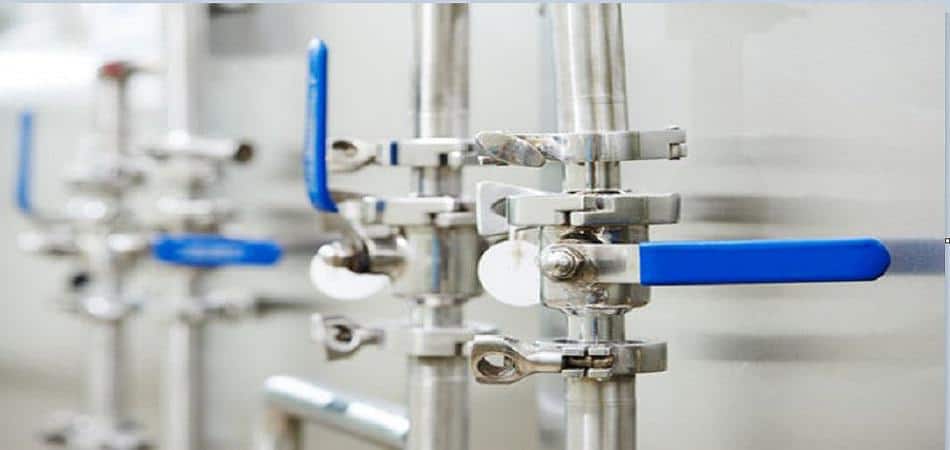
Stainless Steel Ball Valves
Stainless steel is ideal for use in corrosive and severe conditions. This makes it an excellent solution for saltwater, swimming pools, osmosis systems, high temperatures, and various chemicals.
Most stainless steel is austenitic, with the most common types being 304 and 316 stainless steel. Type 316 offers the highest corrosion resistance, whereas Type 304, also known as 18/8, contains 18% chromium and 8% nickel. Type 316 has 18% chromium and 10% nickel, also known as 18/10 stainless steel.
One thing to know is that stainless steel valves often require more power than brass or PVC valves. This is critical when operating a stainless steel valve with an electric or pneumatic actuator.
PVC Ball Valves
PVC, which stands for polyvinyl chloride, is often cheaper than other materials (except for ISO-top valves) and is widely used in irrigation, water supply, drainage, and corrosive substances.
PVC resists most salt solutions, acids, bases, and organic solvents. However, it’s unsuitable for temperatures above 60 °C and can’t handle aromatic and chlorinated hydrocarbons. PVC isn’t as strong as brass or stainless steel, so PVC ball valves have a lower pressure rating.

High-Pressure Ball Valves
High-pressure ball valves are designed to withstand extremely high fluid pressures, typically ranging from 500 to 700 bars. When the valve is larger, it can tolerate less pressure, and vice versa. These valves are highly durable and are utilized in pipe systems with uniformly high pressure. If it is a manual valve, turn the lever 90 degrees to activate it. However, if it is motorized, it will activate in response to an electric signal.
These valves are manufactured from materials like carbon steel and stainless steel 316. Or more durable materials, such as Duplex, for pieces like the stem, ball, and seat rings. This allows the valve to handle high pressure and the maximum torque the actuator can provide.

High-pressure ball valves are available in the following connection types:
- National pipe thread (NPT) threaded
- Compression type (DIN 2353/ISO 8434-1)
- Welding end
- British Standard Pipe Parallel (BSPP) threaded
What’s the difference between 1, 3, and 3-piece Ball Valves?
One-piece Ball Valve
As they are made of a single piece of material, one-piece ball valves are extremely durable and have a low leak rate. However, they have a lower port size due to design than the inner diameter of the pipe to which they connect.
As a result, there may be a little slowdown in the flow and a dip in pressure. Replacing them requires removing the entire valve, which can be a tedious process.
Furthermore, it costs less to manufacture these valves. Therefore, replacing them completely is always an option rather than attempting to fix them.
Pros of One-piece Ball Valves
- Inexpensive
- Fewer chances of leakage
Cons of One-piece Ball Valves
- A smaller port size results in lower pressure
- Repairing can be tricky
Two-piece Ball Valve
Two-piece ball valves consist of two components linked together using bolts or threaded connections. Typically, one part comprises the body and one end connection, while the other holds the trim to the valve and includes the second end connection. This setting enables two-piece ball valves to have port sizes that match the sizes of the connecting pipes. When this occurs, they are referred to as full-port valves. Because full-port valves provide no pressure loss, they can withstand significantly higher flow rates.
Additionally, two-piece valves are designed to bear pressure from both sides, making them ideal for stopping fluid flow in both directions, a process known as bidirectional flow shutdown.
Moreover, two-piece ball valves are often the most cost-effective option among full-port valves.
Pros of Two-piece Ball Valves
- Full port size results in a higher pressure
- Relatively cheaper compared to other full port options
Cons of Two-piece Ball Valves
- The whole assembly needs to be removed to repair
- More expensive than one-piece valves
Three-piece Ball Valve

Three-piece ball valves are a trio of parts: two end caps and a body. Unlike the other types, you can separate the body from the end caps. This makes them super easy to clean and service whenever needed. These valves are ideal for cleaning things up frequently.
They’re pretty popular in industries such as pharmaceuticals and food/beverage, where cleanliness is a top priority. While they might cost a bit more upfront, they’re totally worth it. Why? Because they come with added functions that are absolute must-haves for specific jobs. So, think of them as the superheroes of valves – a bit pricier, but totally worth the extra dough when you need their special powers.
Pros of Three-piece Ball Valve
- Easier maintenance and upkeep
- Long-lasting with regular maintenance
Cons of Three-piece Ball Valve
- Most expensive of all
Connection types for ball valves.
Standard
Standard ball valves are pretty straightforward. They have a ball, seats, a housing, and a lever to spin the ball. Additionally, they have two, three, or four ports in varying sizes, which may feature both male and female threading. Many ball valve manufacturers offer this type of valve.
Flanged
Flanged ball valves are a bit fancier. They hook up to your pipes using flanges designed according to a standard. Their full-bore design enables them to deliver a high flow rate.
Ball valves are, therefore, suitable for any plumbing task, regardless of whether you choose the traditional threaded design or flanged valves.
Socket Weld Ball Valves
Socket-weld ball valves are a specialized type of ball valve designed for high-pressure applications and permanent pipe connections. Unlike standard or flanged ball valves, socket-weld ball valves use a socket-weld connection, where the pipe is inserted into a recessed area at the end of the valve. This design ensures a robust, leak-proof joint, ideal for systems with common high-pressure and temperature variations.
Sizes;
Final Thoughts
There you go! It was all you needed to know about ball valves. Now you can go into the market and purchase the one that best suits your needs. Plumberstar is a reliable ball valve manufacturer with 20 years of experience. If you have any further questions, please don’t hesitate to contact us.