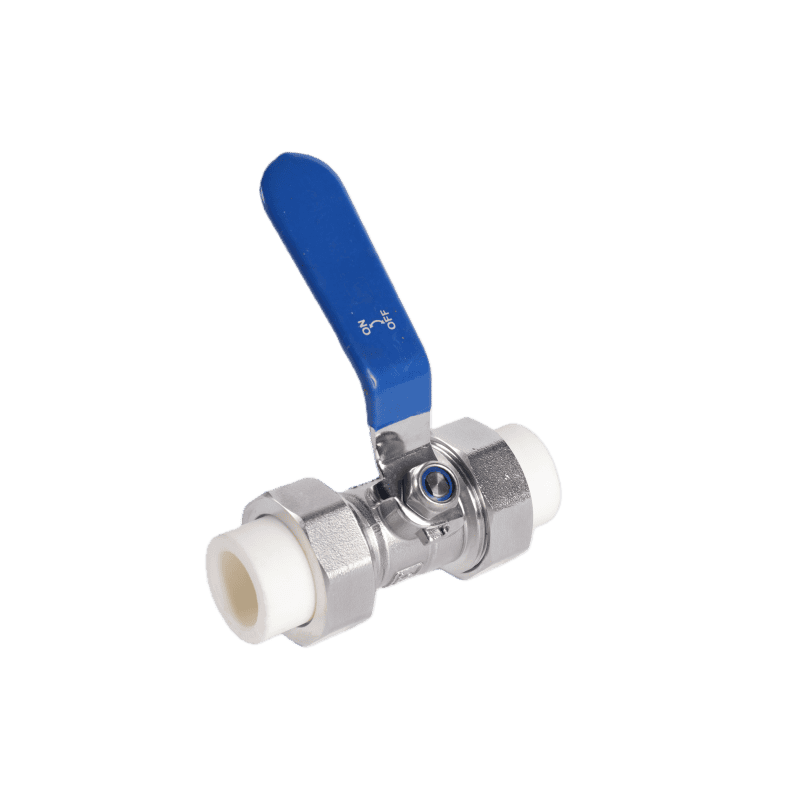
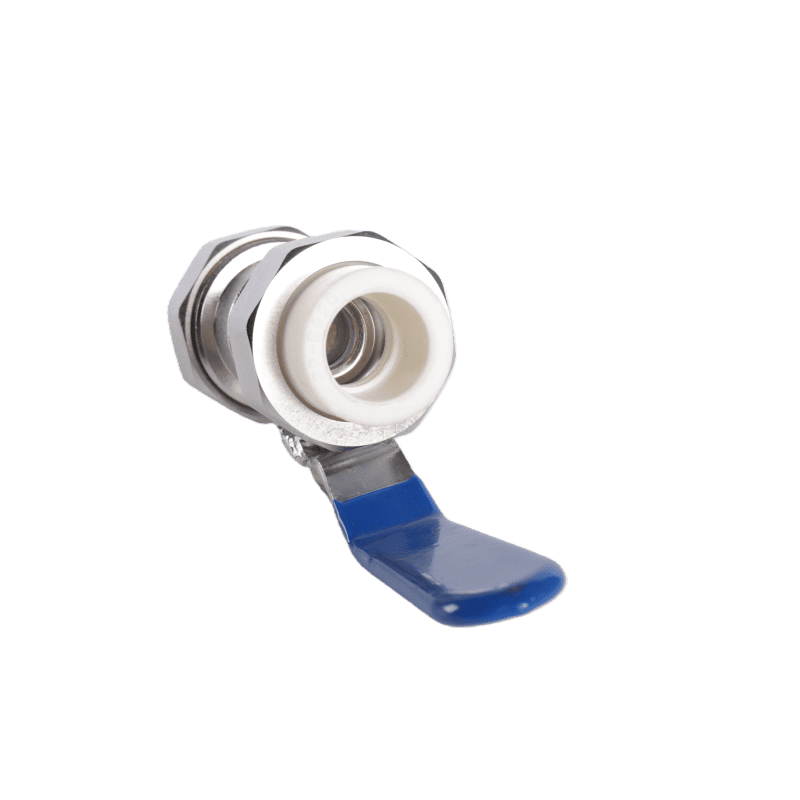
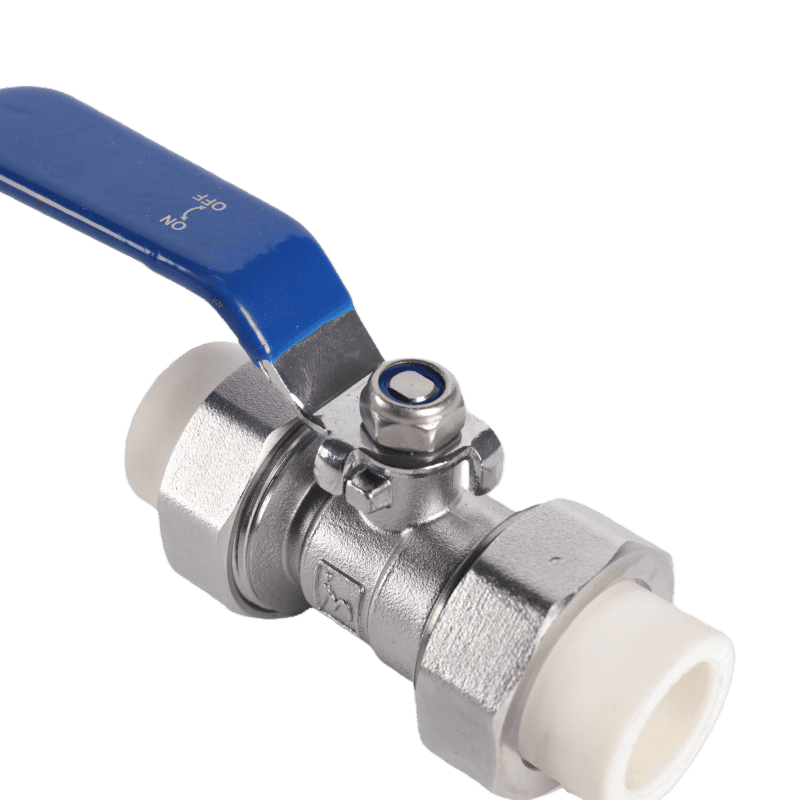
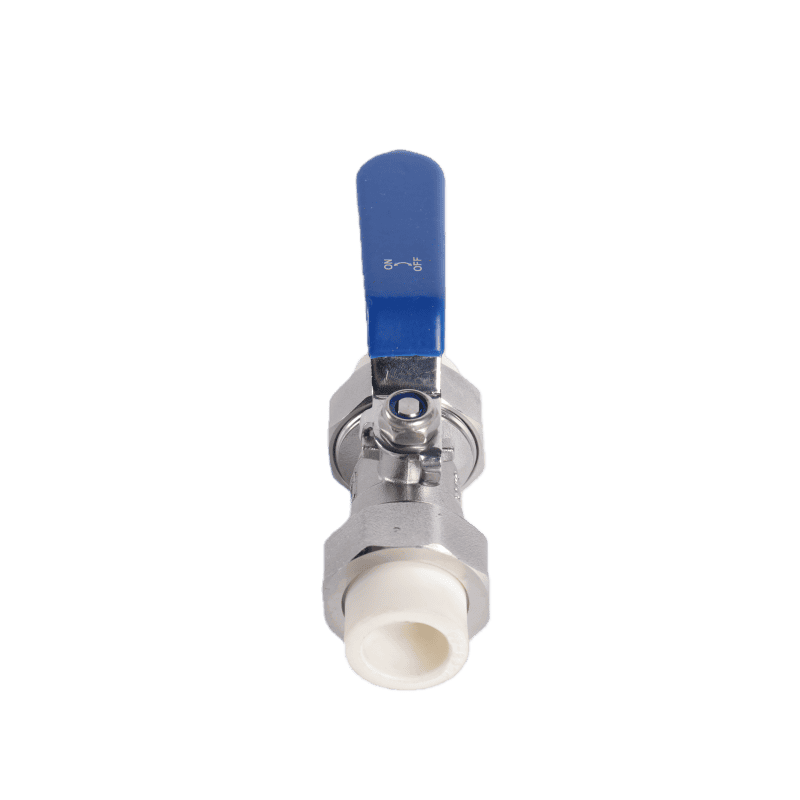
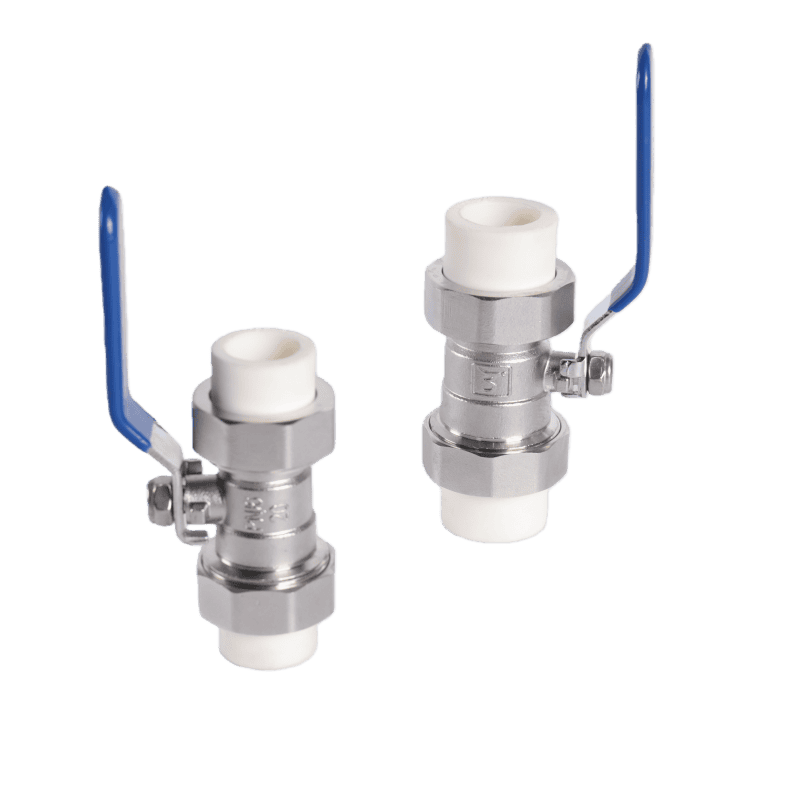
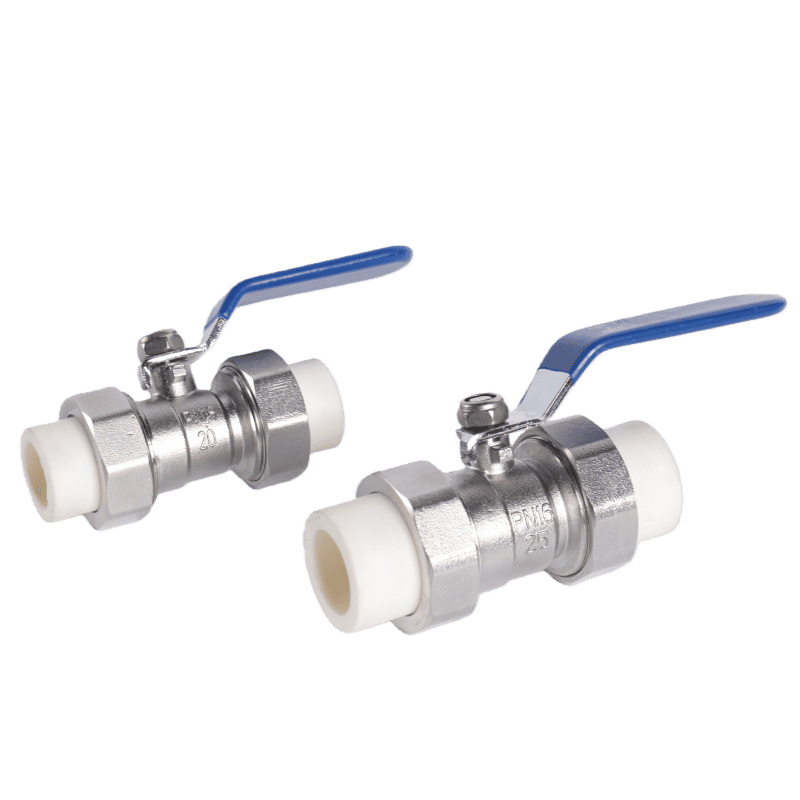
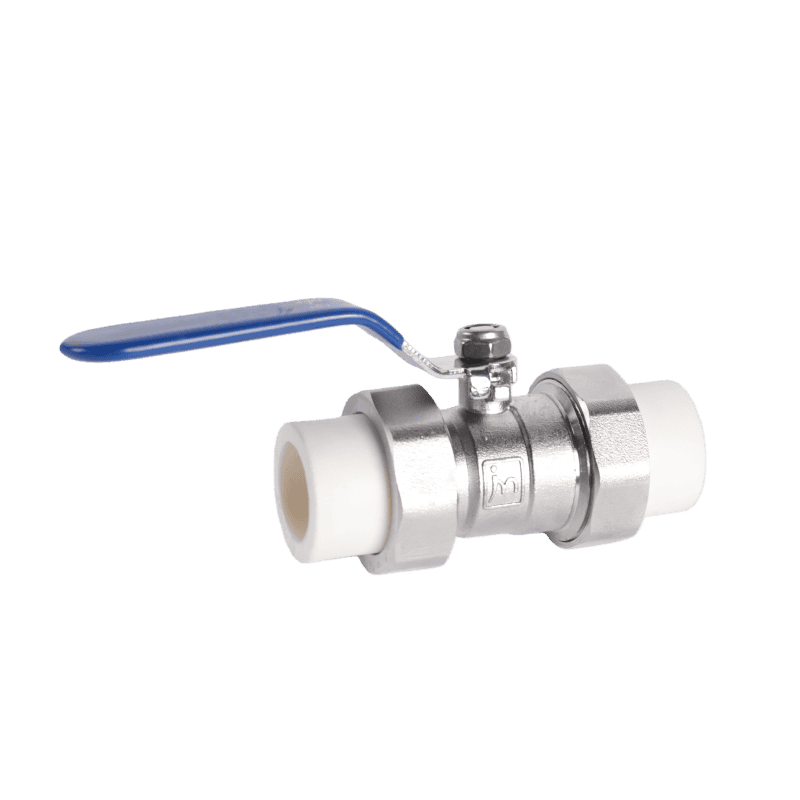
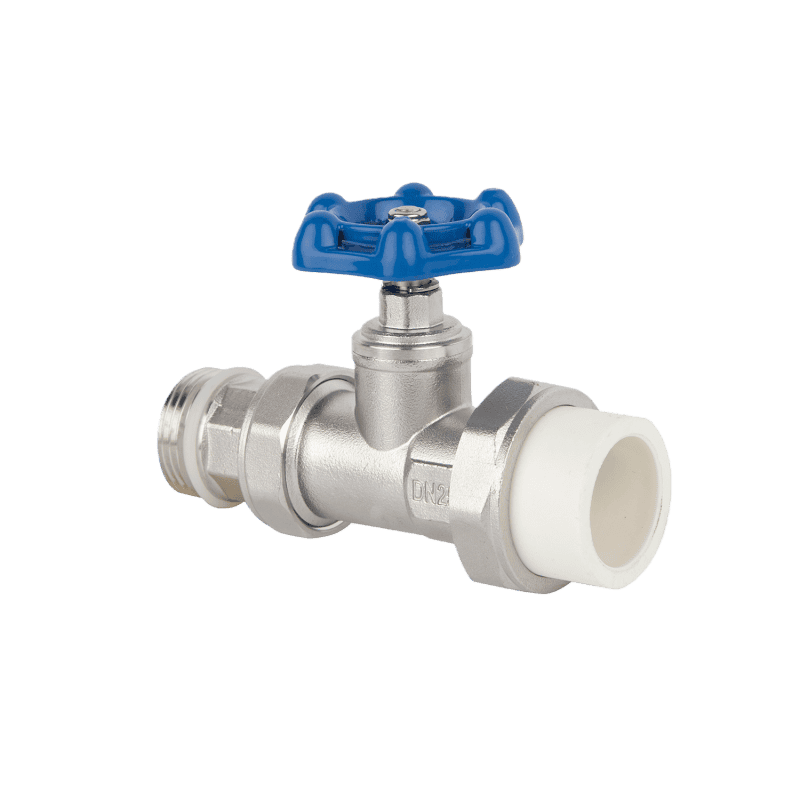
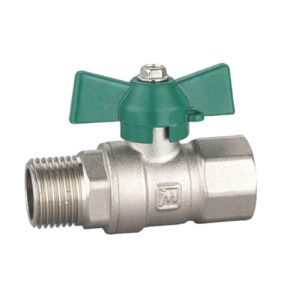
This PPR double union ball valve uses PPR plastic ports, a stainless steel valve core, and a blue handle. It is designed to turn water flow on and off in PPR piping systems. Both ends have PPR hot-melt connections, allowing them to connect directly to PPR pipes. The hot-melt joint is tight and reliable, and installation is simple. This valve is commonly used for branch flow control in residential PPR water supply and drainage systems.
Model No.: JX-10054
Size: 1/2 inch-2 inch
Double Union Socket
Installation type: Welding, Heat Welder
Fast operation type, Easy for on/off by rotating 90 degrees
It’s a PPR pipeline special ball valve made of stainless steel and PPR composite material. It is the core on/off control fitting in PPR water supply and drainage, HVAC, and industrial mild corrosive fluid transmission pipeline systems. Its core use is to accurately control the on/off of water, hot water, purified water, mild corrosive fluid, and other media in PPR pipeline. The valve can be securely joined to PPR pipes via hot-melt or socket fusion connections. This connection method ensures a tight bond and excellent sealing performance, effectively preventing leakage.
Model No.: JX-10070
Size: M1/2″, M3/4″,M1″
PPR size: 15mm, 20mm,25mm
Material: 304 Stainless steel
Connection: Thread, PPR
Seal type: Soft seal type
Meduim: Water
O-ring in EPDM
Working pressure: 2.5MPa
Working temperature: -10-120℃
Handle: Steel hexagonal valve handwheel
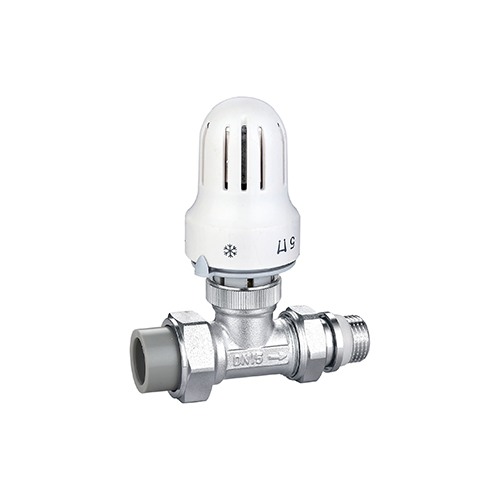
Thermostatic Radiator Valve with Straight type PPR
The thermostat radiator valve is directly connected using a material called PPR. It is a special temperature control accessory for radiators in HVAC heating systems. The core use is to automatically and accurately control the inlet temperature of radiators. It senses the indoor temperature changes in real-time. The built-in temperature sensing elements automatically adjust the valve opening to control hot water flow.
Model No.: JX-0605
Size: 1/2″, 3/4″, 1″
Finishing: Nickel-plated
Working temperature: 0-110℃
Working pressure: 1.6MPa
Medium: Water
O-ring material: EPDM
Thread Type:G/BSP228
Straight Type
Installation type: Heat Welder
With a thermostatic head
Structure:Control
Double Ferrule Bar Stock Ball Valves
This double ferrule ball valve is made from a one-piece stainless steel bar body and comes with a blue extended lever handle. It is used for on-off control in high-precision piping systems. Both ends use double ferrule connections. This design works well with rigid pipes and helps prevent leaks. The valve is commonly used in chemical systems, instrumentation lines, and hydraulic pipelines where stable and accurate flow control is required.
Model No.: JX-0412
Size: 1/8 “- 1-1/2”
Material: SS316 stainless steel
Standard: ASTM
Seal Material: PEEK/PTFE
Type: Fixed Ball Valve
Pressure: 6000psi
Connection: NPT/BSP
Power: Manual
With a stainless steel handle
Temperature of Media: -40-450°F
Application: Industrial Usage
Brass Ball Valve with air vent
This brass ball valve with an air vent has a solid brass body and a yellow butterfly handle. It is used to turn the flow on and off and to release trapped air from the pipeline. The valve has a straight-through design. One end uses a female thread, and the other end uses a male thread for easy pipe connection. A small vent port with a plug is set on the side of the valve body for air release when needed. This valve is a practical choice for piping systems that need both flow control and simple air exhaust.
Model No.: JX-0406
Size: 1/2″, 1/4″, 3/4″, 1″
Material: CW617N, C37700, CW602N
Equipped with a yellow butterfly handle
Finishing: Nickel-plated, sand-blasted
Max working pressure: 200WOG
Working temperature: -10-120℃
Handle material: Aluminum
Connection: NPT/BSP
With a 2-year warranty
Medium: Water
600WOG Flanged Ball Valve
This 600WOG flanged ball valve uses a solid brass body and a blue lever handle. It is built for on-off control in high-pressure piping systems. The valve comes with a metal flange base with pre-drilled holes. This allows the valve to be firmly fixed to a wall or equipment surface for stable use. It is commonly used in industrial branch pipelines and commercial water supply systems where high-pressure strength and secure mounting are required.
Model No.: JX-0417
Size: 1/2″-1″
Material: Brass
Working Pressure: 600WOG
Working Temperature: -20-120℃
Ball/Steam material: Brass
Seal material: PTFE
Flange: Brass
Finishing: Original
Type: Fixed Ball Valve
Bore: Reduce Bore
Standard: ACS, CE
Handle: Aluminum handle with rubber cover
Full Port Ball Valve With Drain
This full-port ball valve with drain features a brass body and a black extended handle, serving as a dual-purpose valve that delivers high-flow on-off control and blowdown functionality for piping systems. It comes with through-type ports at both ends for seamless pipeline connection. A drain outlet fitted with a knob is located on the valve body side. This valve is well-suited for industrial pipelines and HVAC systems where high flow and regular draining are required.
Model No.: JX-0422
Material: C37700, CW617N, Lead-free brass
Size: 1″, 1/2″, 3/4″
With waste drain
2-Piece brass ball valve
Finishing: Sand blasted
Working pressure: 600WOG
Handle: Iron handle with sleeve
Connection: BSP/NPT
Working temperature: -10-120℃
Seal material: PTFE
90-degree valve closing range
FAQs of PPR Double Union Ball Valve
1. What is the structure of the PPR double union ball valve?
Plumberstar PPR Double Union Ball Valve uses a split structure. It has a middle valve body and two union joints on both ends. The design focuses on easy installation, fast maintenance, and reliable sealing. It is widely used in PPR hot and cold water systems. It is a common control valve for many plumbing projects.
Both sides of the valve have a double union structure. Each side includes a PPR union body, a union nut, and a sealing ring. The PPR union end can be directly welded to PPR pipes.
The biggest advantage of this structure is maintenance. You don’t need to cut the pipes when repairing or replacing the valve. You only need to loosen the union nut to remove the valve. This greatly improves maintenance efficiency and lowers construction costs.
In terms of performance, the valve body is strong, and the inner flow path is smooth. It effectively reduces pressure loss.
The double union split structure makes installation more flexible. It also makes disassembly much simpler. It works well for indoor and outdoor plumbing, heating, HVAC, central air conditioning, and water treatment pipelines.
Plumberstar thought about real project needs during the design. We optimized it for long-term hot and cold water use and frequent opening and closing. This ensures the valve keeps stable sealing and long service life even in complex environments.
From Mako Products – Superlok TV
2. How to ensure the material consistency of PPR double union ball valves?
Plumberstar PPR Double Union Ball Valve has a complete, stable material control system. It covers raw material purchase, production, inspection, and delivery. Every step can be traced.
Every batch of raw materials comes with original documents: material report, composition certificate, and hygiene test report from the supplier.
Plumberstar manages raw materials strictly: we store them in different areas, sort them, and label them clearly. Raw materials of different models, colors, and sizes are kept separate. This stops material mixing and wrong usage from the start.
After raw materials arrive, our quality inspection team samples and rechecks them. We check key indicators: melt flow rate, density, heat resistance, and impact resistance. Only qualified raw materials can be used for production. This ensures all PPR parts (valve body, double union joint, etc.) use consistent materials.
We use fully automatic, standard production processes. All injection molding equipment has fixed parameters: temperature, pressure, speed, and pressure-holding time. The system controls them uniformly. This keeps each product’s density, wall thickness, and strength stable.
For core internal parts: sphere, valve stem, valve seat, gasket, and metal nut, we use strict, uniform material standards. Spheres and valve stems are fixed with qualified copper alloy or stainless steel. Every batch gets material composition testing.
Every batch of products has a unique batch number. You can trace back to the raw material batch, production equipment, operator, and inspection records. We achieve full traceability from finished products to raw materials.
3. Can PPR double union ball valves be supplied consistently for repeat orders?
Plumberstar can give you a clear promise. Our PPR double union ball valves can support long-term, stable, and continuous repeat orders.
Whether you need regular restocks, bulk reorders, or long-term fixed orders, we can provide a reliable supply. We have large, professional production lines for PPR valves and fittings. We will not stop production, cut supply, or lower quality because of order changes, seasons, or short-term raw material price swings.
We plan production and raw material stock in advance based on your past order data. Regular models always stay in sufficient stock and support fast production. We can respond to your reorders quickly and reduce stockouts and delays that hurt your business and projects.
PPR double union ball valves for repeat orders, always use the same formula, same molds, same process, and same quality control. Every batch is consistent in size, structure, material, sealing, and installation. You don’t need to test or adapt again after reorders. You can use them directly for projects, sales, and after-sales replacement.
We give priority to fixed repeat order customers. They get priority production, priority inspection, and priority delivery. We provide a complete guarantee from production, storage, logistics, to after-sales.
Whether you order small batches often or large batches regularly, Plumberstar keeps a stable supply and service. We let long-term partners feel safe and worry-free. We build long-term, stable, and win-win cooperation.
4. How to protect OEM designs and brand info for PPR double union ball valves?
Plumberstar takes your intellectual property and commercial information seriously. This includes your OEM designs, drawings, molds, logos, packaging text, and product sizes.
We manage your information and design materials strictly. All OEM-related materials — drawings, 3D models, parameters, structure plans, custom sizes, brand documents — are confidential. A special department keeps and manages them uniformly. Only technical, production, and quality inspection staff on the project can access them. Irrelevant staff cannot get access.
For your special molds and tooling, we use an exclusive, independent management system. Molds developed for you belong fully to you. They are only used to make your PPR double union ball valves. We never use them for other customers, copy them, or give them to others.
Each mold has a unique number. We store them separately and assign special staff to manage them. Every time we use or produce with them, we keep a record. This ensures full control and traceability. It fully protects your exclusive structure and appearance designs.
We always follow one rule: protecting your OEM assets is protecting our own reputation. You can trust us with your PPR double union ball valve custom designs and brand customization. We provide the strictest confidentiality and management. We help protect your brand and market development.
5. What quality tests are performed on the PPR double union ball valve?
When raw materials arrive, we test the PPR pellets. We check melt flow rate, density, heat resistance, and impact strength. We also test for hygiene and safety. We only use new, food‑grade materials. No recycled materials or harmful impurities are used. They meet drinking water contact standards.
During production, we check appearance and size. The valve body must have an even color, no bubbles, no deformation, and no cracks. Double union joints, nuts, and connecting parts must have consistent sizes. Wall thickness must be even and up to standard. This ensures a good hot‑melting connection with pipes and a stable installation.
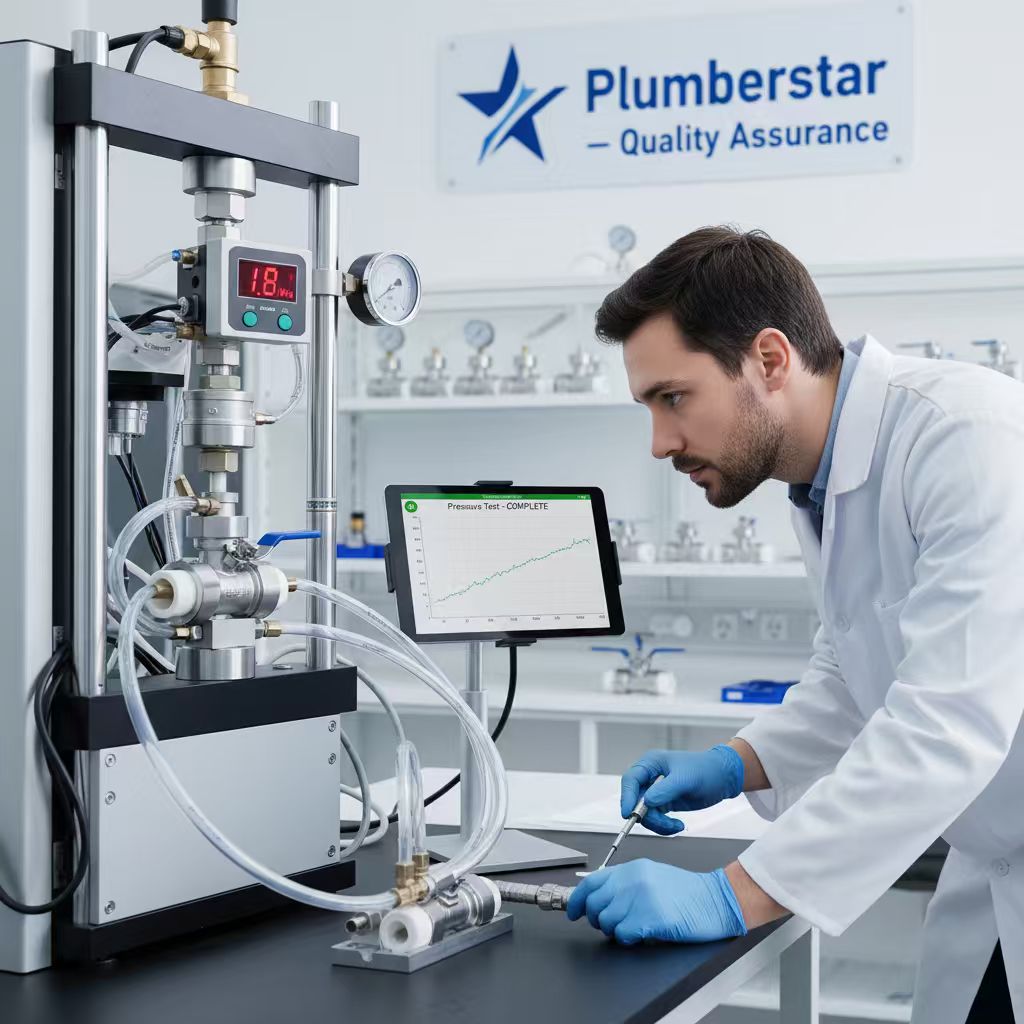
Before finished products leave the factory,we do the most important tests: pressure test and sealing test. We test the whole valve under a set pressure. We make sure the valve body does not break or deform under long‑term pressure. We also test the seal of the valve disc and both union joints. The valve must not leak when closed. The union parts must not leak after locking. They meet long-term use requirements for cold and hot water systems.
We also do switch life tests. We simulate frequent opening and closing in real use. We test the durability of the handle, stem, ball, and valve seat. We make sure it still works smoothly and seals well after many uses.
We do high and low temperature cycle tests. We check how the product resists aging and cracking under changing hot and cold conditions. This helps extend its service life.
After each batch is inspected, we issue a factory test report. Each batch gets a unique production number. Full traceability is achieved.
6. What experience of PPR double union ball valve do you have with overseas projects?
Plumberstar has many years of experience in exporting PPR double union ball valves. We supply global customers and overseas engineering projects.
Our products are sold steadily to Europe, the Middle East, Southeast Asia, and South America. They are widely used in water supply and drainage systems: homes, commercial buildings, hotels, schools, hospitals, municipal water, heating, HVAC, and agricultural irrigation. We have full experience in overseas projects and services.
We know the pipe standards, installation habits, customs rules, and certification systems of different countries. We can provide products that meet local standards. These include EU CE, RoHS, UK WRAS, Australian WaterMark, North American cUPC, and more. This helps your goods pass customs, inspection, and project audit smoothly.
For different climates: hot and dry, humid and rainy, or cold areas, we optimize the PPR material and sealing structure. We improve impact resistance and anti-aging performance. We make sure the valve body does not crack or deform. The seal stays stable and reliable for a long time.
For overseas projects, we provide one-stop service: early technical talk, drawing confirmation, sample test, OEM customization, packaging design, export declaration, logistics tracking, and after-sales support.