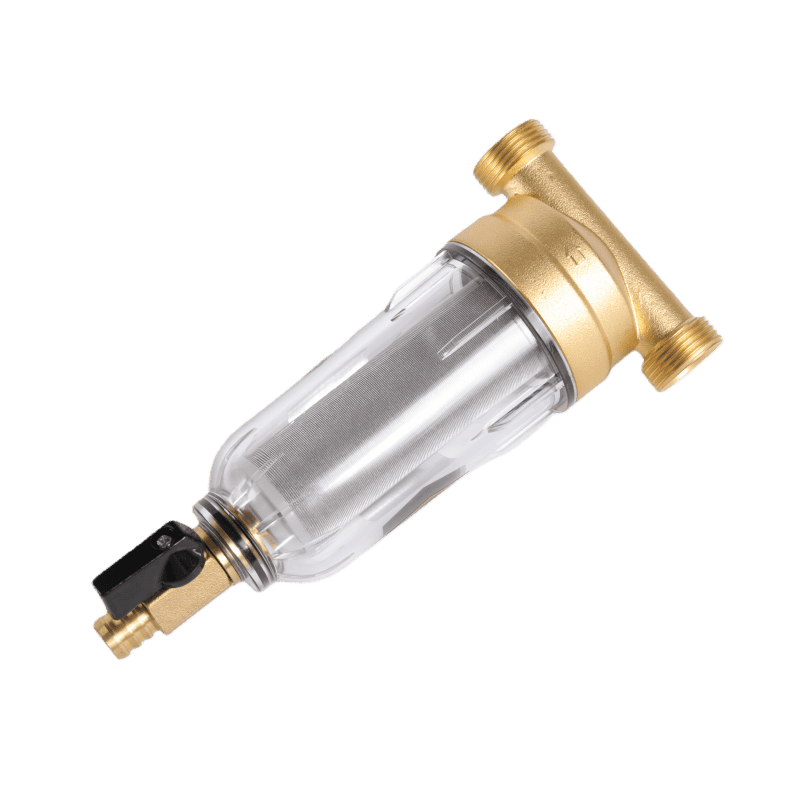
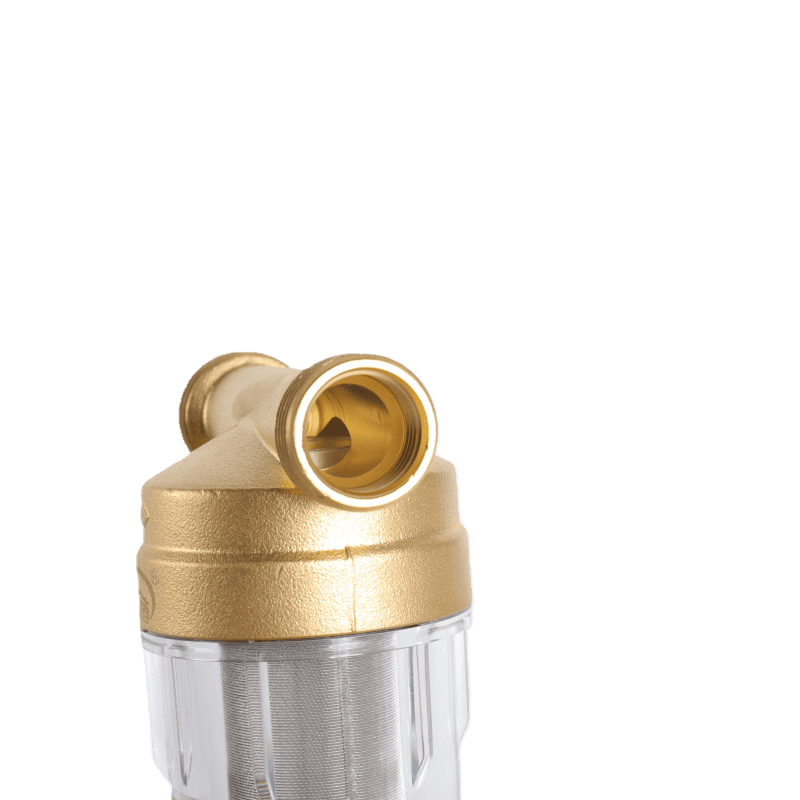
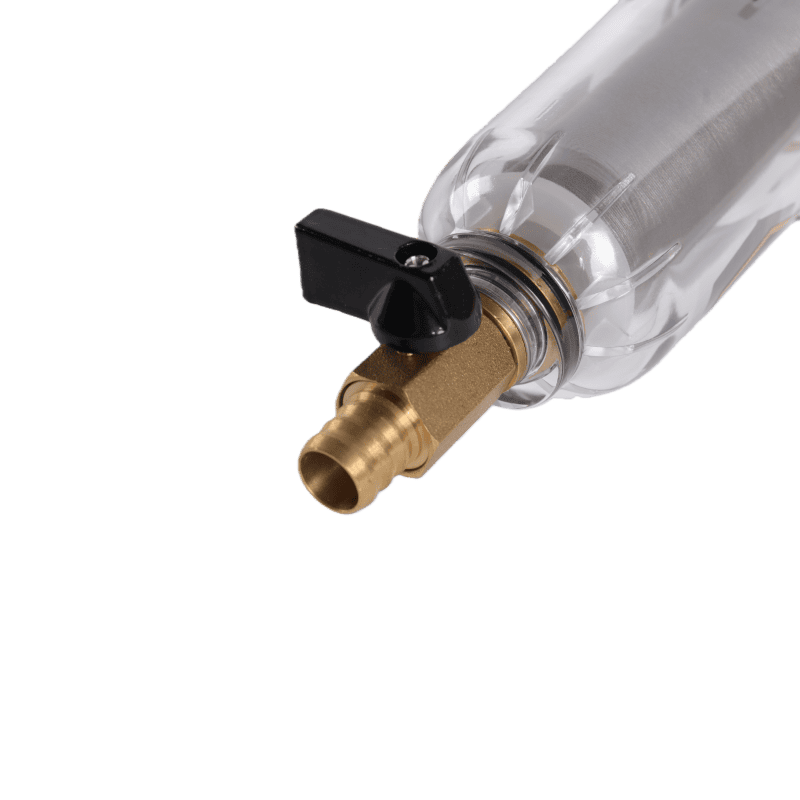
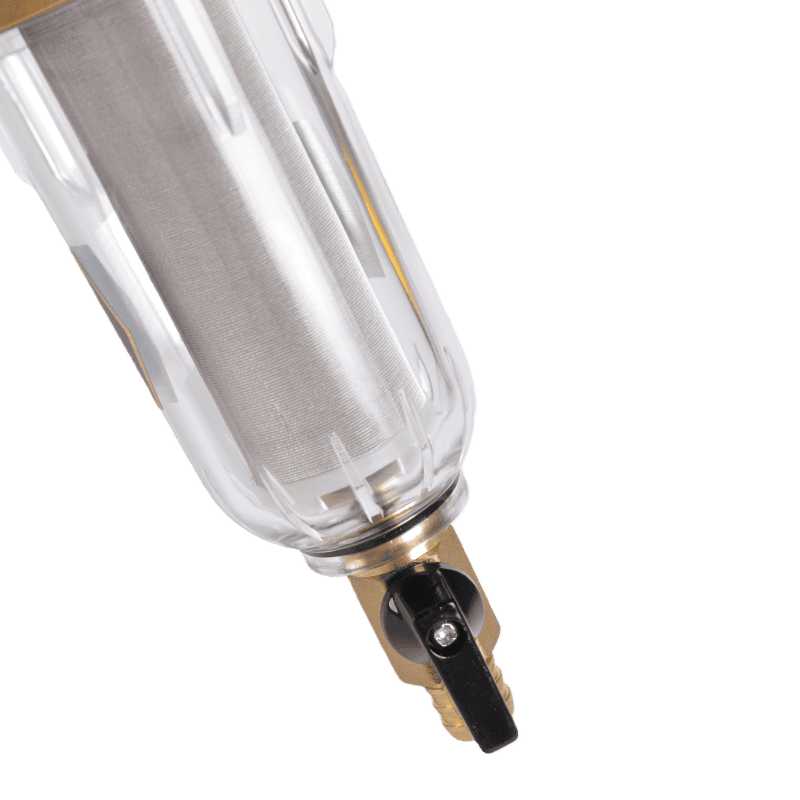
This brass clear-housing pre-filter is made with a lead-free brass body and a transparent PP housing. A stainless steel filter element is built inside. It is used as a pre-filter in home water supply systems. The filter has straight-through flow and threaded connections on both ends. A blowdown ball valve is installed at the bottom. The clear housing allows users to see dirt and buildup inside. The stainless steel filter catches large particles like sand and rust. The filter is usually installed at the inlet of household water pipelines. It works as the first filtration step in home water purification systems.
This three-way valve is designed for washing machine water supply lines. It uses a T-shaped flow path to direct the water. The valve has quick-connect ports for easy connection to washing machine inlet hoses. A blue handle is mounted on the valve. Turning it 90° switches the water flow. This valve is made for home washing machine pipelines and allows a separate water supply from the wall pipe to the machine.
Model No.: JX-0418
Material: Brass
Size: 1/2″X1/2″X3/4″
Finishing: Sand Blasted
Standard: En331
Thread Standard: BSP
Seal Material: PTFE
Handle: Polymer Handle
Ball/Stem material: Brass
Type: Tee
Max working temperature: 85°C
Max working pressure: 16bar
PVC Three-Way Valve
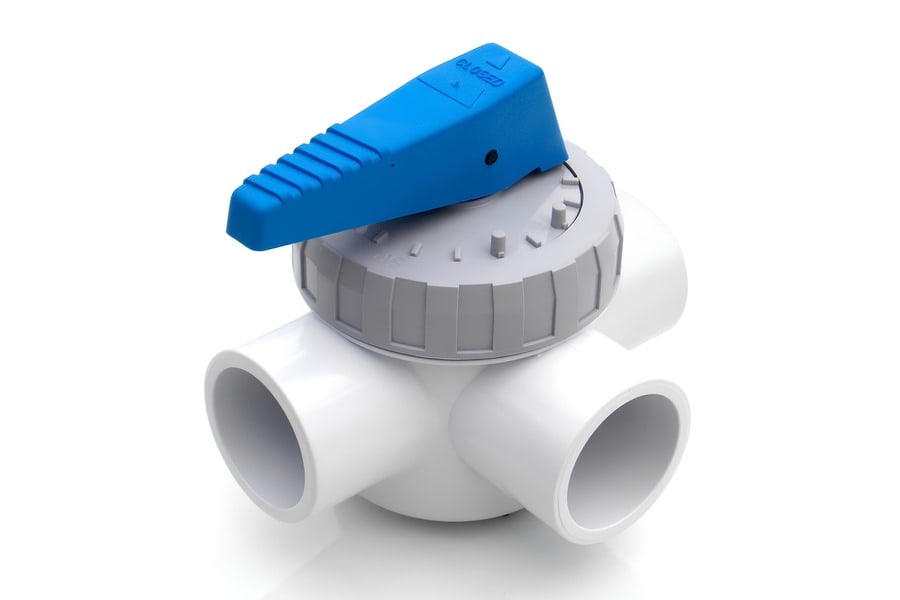
This PVC three-way valve is used for low-pressure piping systems that need corrosion resistance. By turning the valve core, the valve enables medium diversion, confluence, and reverse flow within the pipeline. The valve supports both one-inlet two-outlet and two-inlet one-outlet flow setups. It works for water supply and drainage, sewage treatment, chemical fluids, farm irrigation, and swimming pool systems.
Material: ABS, PVC
Size: 40mm
Seat seal material: EPDM
Designed for PVC pressure pipe and fittings.
Used for diverting, mixing, or on/off isolation
Installation: Use PVC pressure pipe adhesive
Large handle for easy adjustment
Able to withstand extreme chemical and temperature fluctuations
Max working Pressure: 4bar
Ball material: PVC
With a PTFE O-ring
Float Valve
This brass float valve is used for automatic liquid level control in tanks and reservoirs. It comes with a gear-type adjustment handle for easy setting. The valve uses an L-shaped flow path and has an external threaded connection. It connects directly to the tank inlet or outlet pipes. The float level can be adjusted by turning the gear handle. This allows the user to set the required liquid level height. The float moves with the liquid level.
Model No.: JX-0754
Size: 1″, 1/2″, 3/4″
Material; Bronze, CW602N, CW617N
Connection: BSP, NPT
Adjustable arm allows for setting automatic on/off
Inlet Connection Type: Flange
Outlet Connection Type: Female
Standard: ASME, ASTM
The serrated arm allows adjustment of the water level
Dual inlet thread for connecting pipe and locknut
Working pressure: 0.1MPa
Working Temperature: -5-60˚C
Medium: Water
FXM Mini Ball Valve
This chrome-plated brass miniature ball valve is a user-friendly flow control component designed for small-diameter piping systems. It boasts a one-piece cast construction, with a male threaded connection on one end and a female threaded connection on the other. It is widely used in residential water heaters and is fully suitable for confined installation spaces.
Model No.: JX-0413
Size: 1/2″FXM,3/8″FXM,1/4″FXM
Material: CW5110L, CW602N, CW617N
Finishing: Chrome-plated
Operation: Manual
Connection: BSP/NPT
Seat seal material: PTFE
Double–seal system
Handle: Red Aluminum alloy handle
Working Temperature: -15-100℃
Working pressure: 200psi
Quarter-turn for on/off
Brass Ball Valve Reduced Port
This brass reduced-port ball valve, fitted with a blue locking handle. Serves as a cost-effective on-off control component for medium and low-flow pipelines. Its reduced-diameter flow channel is designed specifically to match the requirements of medium and low-flow piping systems. Widely used in residential bathroom branch lines, small HVAC circuits, and laboratory low-flow fluid pipelines. It stands out as a highly cost-efficient valve solution for such flow scenarios.
Model No.: JX-0406
Material: Brass
Size: 1/2″, 3/4″
Finishing: Sand Blasted
Working Pressure: 30bar
Working Temperature: -10-110ºC
Ball/stem material: Brass
Forged brass with a lock
Seal material: PTFE
Connection: NPT
100% water pressure and leak tested
Handle: Lever Blue butterfly lever handle for manual on/off control
Two-Piece Body – reduced Port
Standard: En331
Flanged Brass Isolation Valve
This flanged brass isolation valve is used for large-diameter pipelines. It uses flange connections for a firm and secure fit. The design provides good sealing and helps reduce vibration during operation. This valve is commonly used in industrial fluid mains, municipal water supply branches, and large HVAC system pipelines.
Model No.: JX-0441
Material: C37700, Lead-free brass, CW511L
Size: 3/4″
Finishing: Sand blasted
Working pressure: 600psi
Temperature range: -10-110ºC
Design of a rotating flange for the valve body with a full flow passage
Standard: ANSI
Handle: Lever steel handle with rubber cover
Blow-out proof stem
Seal material: PTFE
EPDM O-ring
Full port
FAQs of Water Purifier Filter Valve
1. Can the water purifier filter valve be used for cold and hot water lines?
Absolutely not. Plumberstar water purifier filter valves are only for cold water pipelines. You must not connect them to hot water systems.
The valve body is made of brass or stainless steel. It can handle hot water temperatures structurally. But the internal filter parts cannot resist high heat. This is the main reason it cannot be used in hot water lines.
Filter element: PP cotton, activated carbon, UF membrane, and RO membrane are all plastic materials. They are very sensitive to high temperatures.
Connecting the filter valve to hot water will cause permanent damage.
Filter softens and deforms, water bypasses directly, and filtering fails completely
UF and RO membranes are destroyed by heat, cannot be repaired, and must be replaced
Sealing rings age and deform at high temperatures, causing leaks or even bursting
Activated carbon adsorption drops sharply, purification effect is greatly reduced
2. What is the filtration accuracy and flow range of the purifier filter valve?
The filtration precision covers 5μm, 10μm, 20μm, 50μm and 100μm. It suits different water purification scenes. Conventional working flow rate: DN15 model 8-12L/min, DN20 model 15-20L/min, DN25 model 25-30L/min. The working pressure is 0.1-1.0MPa. With the same filtration precision, the Plumberstar filter element has a 35% larger flow area than its competitors. The flow rate is more stable. The long-term use flow attenuation rate is ≤5%.
3. What is the sewage discharge method of the water purifier filter valve?
The valve uses a manual quick-open sewage design. A sewage outlet and sewage valve are built into the bottom of the valve body. By turning the sewage handle about 30°, sewage discharge starts. Some models also support automatic sewage with timing control. These are suitable for large commercial water purification systems. Compared with competing products, traditional filter valves usually need to be taken apart and cleaned. This process takes about 5–10 minutes. Plumberstar’s design improves sewage efficiency by more than 80%.
4. What’s the difference between ultrafiltration and RO water purifiers?
Plumberstar water purifier filter valves work with two kinds of water purification systems: ultrafiltration (UF) and RO reverse osmosis. These two systems are very different in filtration principle, precision, water quality, and system pressure. So we have designed special filter valves for UF and RO systems separately. This makes the systems run safely, stably, and durably.
Ultrafiltration water purifiers use UF membranes for physical filtration. The precision is about 0.01–0.1 microns. The filtered water keeps natural minerals and is similar to mineral water. It is mostly used for daily water, washing vegetables, and cleaning. If the original water quality is good, it can also be drunk directly.
RO water purifiers use RO membranes. Their filtration precision can reach 0.0001 microns. Reverse osmosis needs to work under high pressure. They can effectively remove heavy metals, scale, antibiotics, pesticide residues, bacteria, viruses, and soluble salts. It is mainly used for scenarios that need very high water quality, such as direct drinking, making milk, making tea, and cooking soup.
From Fresh Water Systems
5. Can the water purifier filter valve’s outlet connection be customized?
Absolutely. Plumberstar water purifier filter valves support customized outlet connections. Just tell us your water purification equipment’s structural design, pipeline layout, installation space, and interface specs. We’ll adjust flexibly to make sure it matches your whole system perfectly and is easy to install.
Customization Process Steps: You can provide design drawings, physical samples, or specific interface parameters. Our Plumberstar engineering team will do a technical evaluation. Then we’ll give you a customization plan and 3D renderings for you to confirm. Once you approve the plan, we’ll make the first sample. We’ll fully test its interface size, sealing performance, and installation adaptability.
Quality and Safety Assurance: Every customized outlet filter valve goes through 100% pressure resistance and tightness tests before leaving the factory. This ensures customized products have the same quality.
6. Can the packaging of the water purifier filter valve be customized?
Plumberstar water purifier filter valves offer full packaging customization. We meet your needs for different brand positioning, sales channels, and export markets.
You can choose different packaging solutions based on product features and transportation needs. These include white card boxes, color boxes, kraft paper boxes, color gift boxes, blister packaging, neutral packaging, and export-specific outer boxes.
We’ll customize the right packaging size for you. We base it on the filter valve model, how many products fit in each box, and the accessory combination. This reduces internal gaps, increases packing density, and cuts down on damage and logistics costs during transport.
We can print your brand logo, product name, model, technical parameters, usage diagrams, warning instructions, certification marks, barcodes, and QR codes on the packaging. This meets your brand display, market promotion, and compliance needs.
We can add foam, sponge, blister inner trays, or paper card positioning structures based on the product design. This ensures no shaking, scratching, or damage during transport. We also support packing accessories together—like instruction manuals, certificates of conformity, sealing gaskets, and installation joints. This way, you get a one-stop shipment.
7. What is the competitive advantage of water purifier filters?
Plumberstar water purifier filter valves meet all requirements for household and commercial water purification equipment. This includes safety, durability, and easy installation compatibility.
The valve body and all water-contacting parts are made of high-standard lead-free brass or eco-friendly engineering plastic. This effectively prevents heavy metal leakage and fully meets drinking water hygiene and safety standards. The sealing parts use food-grade safe materials like silica gel and EPDM.
Inside the filter valve, we use a large-flow, low-resistance flow channel design. It effectively reduces pressure loss in the water purification system, ensuring sufficient water output and that the equipment runs efficiently and stably. The internal fluid structure is optimized for filtration and reversing.
The product uses a double-sealing ring and a high-precision matching structure. It forms full sealing protection from the interface to the valve core. It can handle frequent start-stop and water pressure changes in the water purification system easily. There’s no leakage even after long-term use, and it has better overall stability and a longer service life.
8. How does the compact design benefit purifier manufacturers?
The compact valve design uses less primary material, such as stainless steel and brass, which are widely used in Plumberstar products. Because of this, raw material costs are lower.
This structure also improves material use during production. At the same time, the smaller size makes the valve easier to assemble on automated production lines. Assembly becomes faster and more stable. For water purifier manufacturers, this means lower component costs.
In addition, Plumberstar filter valves use a compact design with standardized interfaces. As a result, manufacturers can connect the valve to various pipelines and control systems without altering the internal structure of their products.