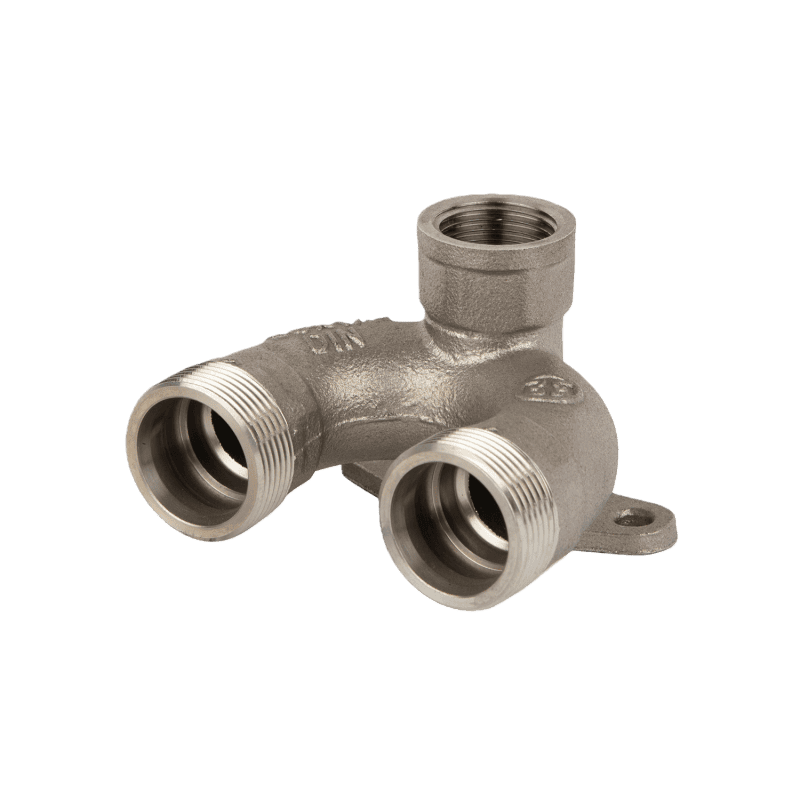
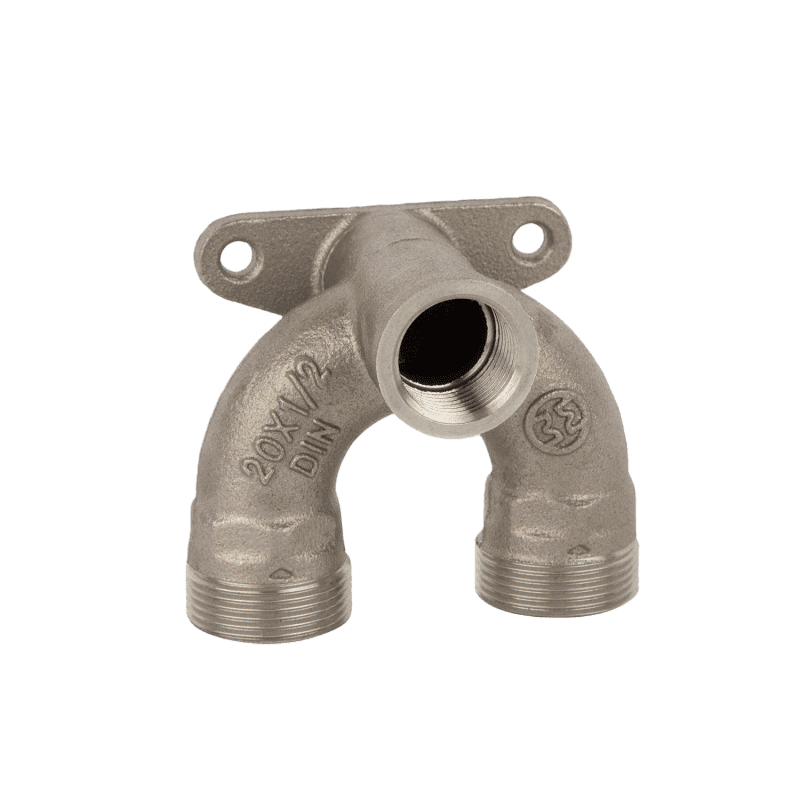
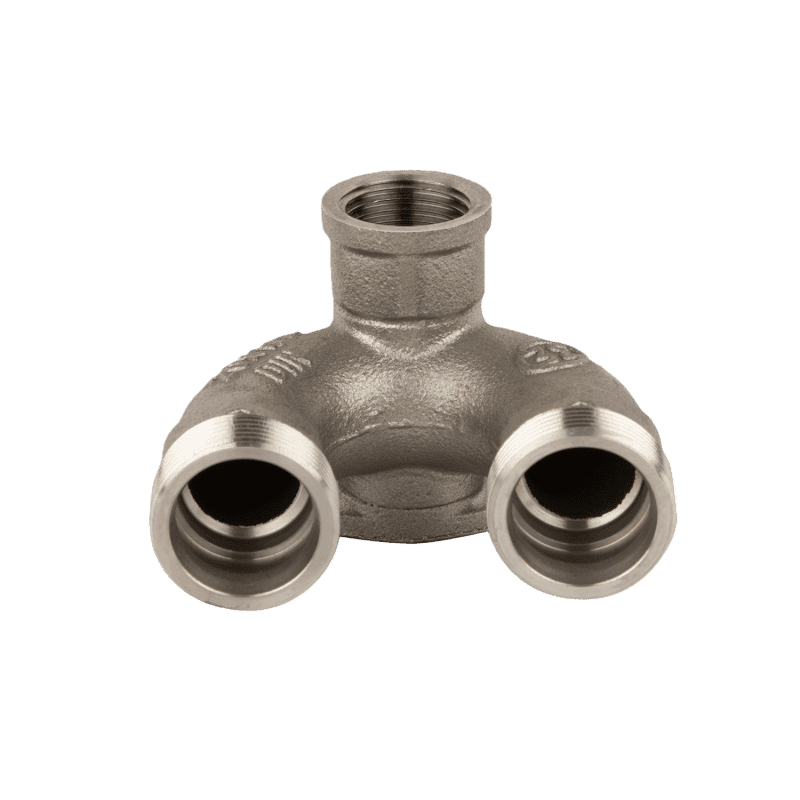
This stainless steel double-wall plate tee is a specialized branch connector designed for use in double-wall piping systems. It features a three-way structure with female-threaded ports on all three ends. A mounting plate is affixed to the side, which can be secured to walls or equipment surfaces to boost overall stability. This component can split the flow from a single double-wall main pipeline into two branch lines.
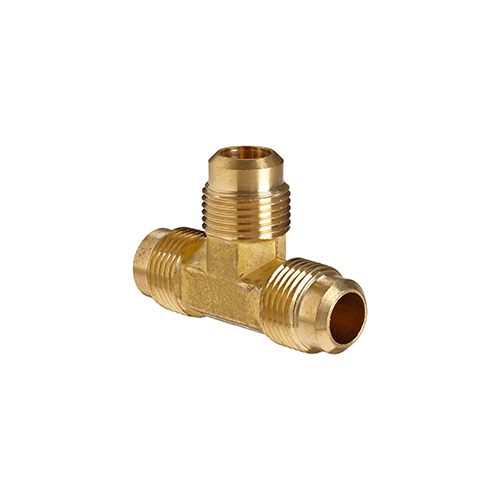
This brass flare branch tee is a full-brass piping connector engineered for bypass flow management in fluid systems. Boasting a T-shaped structure, it features flared male-threaded ports on all three ends—perfectly suited for flared pipeline connection methods. This tee enables two key functions: splitting the medium flow from a single main pipeline into two branch lines, or merging flows from two separate pipelines into one. It is ideally designed for piping layouts that require flow branching or confluence.
Model No.: JX-0836
Size: 1/2″FX1/2″FX1/2″F, 3/8″FX3/8″FX3/8″F
Material: Lead-free brass, C46500
Connector Type: Tee
Thread Type: NPT/BSP
Connection: Flare x MNPTF
Max Working Temperature: 120℃
Max Working Pressure: 1000psi
Standards: SAE J512, SAE J513
Finishing: Sand blasted
Fossil Fuel Fitting
This brass fossil fuel fitting is designed for transmission pipelines that carry oil, natural gas, and other fossil fuels. The fitting has a two-part structure: one end uses a male thread, while the other end uses a female thread with a locking clasp. The fitting achieves fast, leak-tight pipeline connections through a combined thread screwing and clasp-locking mechanism, making it ideal for meeting the splicing requirements of fossil fuel transmission pipelines.
Model No.: JX-0856
Size: Custom
Connection: NPT, BSP
Material: Brass
Finishing: Original
Quick connection and disconnection
Turn clockwise until tightened
Can be customized to the specific needs
With a 3-year warranty
Applications: Oil Extraction
Cast Brass Cleanout Swing Tee
This cast brass cleanout swing tee features a three-way structure integrated with an elbow. Its main flow path is an arc-shaped elbow, and a detachable cleanout port with a sealing assembly is fitted on the side. This tee serves two key purposes: it enables branch pipeline connections and allows users to clear pipeline blockages by opening the cleanout port. Ideal for building drainage and sewage pipeline systems.
Model No.: JX-0896
Size: 1-1/2″ x 1-1/4″
Finishing: Chrome plated, Original
Material: Brass
IPS Swing Tee Trap
Cast brass trap
Type: LA tape
With cleanout
Seals material: PTFE
Thread Type: Female
Application: Bathroom/Hotel/Kitchen
Brass Bulkhead Fitting
This brass bulkhead fitting is a specialized sealing accessory designed for pipelines passing through walls or panels. Featuring a brass body paired with a rubber gasket, it comes with a flange plate with mounting lugs on top for secure fixation to panel surfaces. The gasket provides reliable waterproofing and leakproofing protection where the fitting penetrates the panel. This component enables pipelines to pass through from one side of a panel to the other while simultaneously achieving a tight seal and stable fixation. It is ideally suited for applications requiring pipeline penetration through walls or panels.
Model No.: JX-0901
Size: 1-7/8″ flange
Drain: 1″ NPS drain
used in water tanks, towers, water storage barrels, and rain buckets
3-1/4″ L
Material: Brass
Rubber gaskets and a rubber ring
Double-sided protection
Thread Type: NPT
Standard: ISO 9001
Bathtub Drain and overflow kit
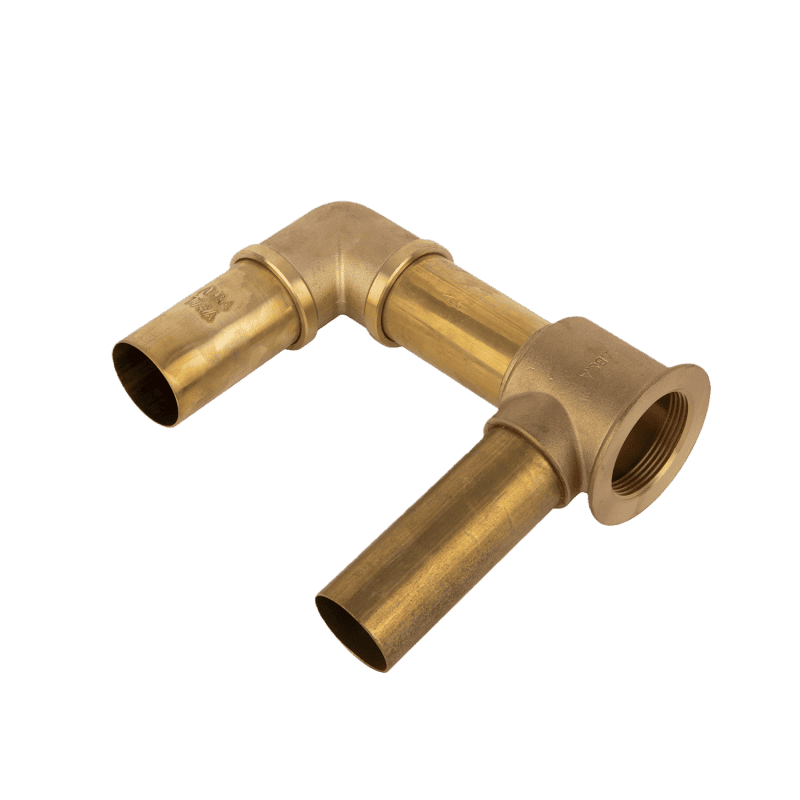
This bathtub drain and overflow kit is a key brass component used in bathtub drainage systems. It combines both drainage and overflow protection in one set. The elbow section connects to the bathtub drain opening and guides wastewater out of the tub. The overflow port, fitted with a flange, connects to the bathtub’s overflow hole. The purpose is to achieve the dual functions of quick drainage and overflow protection for the bathtub, allowing it to drain the bath water efficiently.
Model No.: JX-10065
Size: 3/4″,1″
Finishing: chrome plated
Type: Bath Drain
Max working pressure: 300psi
Working Temperature: 0-110°C
Gauge: 17
Thread Type: NPT
1/4″ Bends
Pre-Adjustable Linkage
Cast Brass Shoe Plug
Brass Tubular Waste End Connection Compl
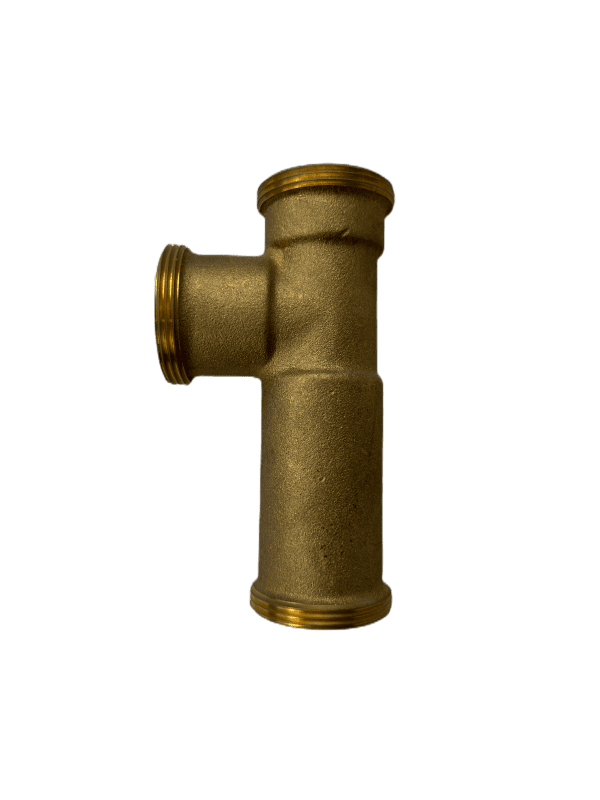
This brass tubular waste end connection component is a specialized adapter fitting designed for the terminal end of drain pipelines. Featuring a T-shaped tubular structure. It has a full-length vertical main channel that runs straight through from top to bottom. A horizontal connection port is fitted on the side. This component allows for connection to the drain pipe terminals of sanitary fixtures such as bathtubs and washbasins, enabling the collection or transfer of drainage branch lines.
Model No.: JX-0804
Material: Brass, C37700
Suitable For: Bathtub
Size: 1-1/2″
Item Length: 5″
Finishing: Sand blasted
Working temperature: -10-120°C
Connection: NPT
On the outside, there is a “normal” slip joint thread
With a 3-year warranty
Power: Manual
FAQs of Stainless Steel Tee joint
1. What is the difference between a reducing tee and an equal tee?
Stainless steel tees are mainly of two types: equal tees and reducing tees. They differ in port size, usage, and connection method.
Equal tees have three ports of the same diameter.Example: DN25 × DN25 × DN25.The main line and the branch line are the same size. Flow and pressure stay almost the same after branching. They are used for connecting pipes of the same size. Suitable for water, gas, and chemical lines with equal diameter splitting.
Reducing the number of tees has different port sizes. Usually, the main pipe is larger, and the branch pipe is smaller.Example: DN32 × DN32 × DN25.They split a small pipe from a large pipe. No extra reducer is needed. Used in building water supply, heating, industrial pipes, and water treatment systems.
Plumberstar stainless steel tees are made of 304/316 stainless steel. They are pressure‑resistant and corrosion‑resistant. Meet food‑grade and industrial‑grade standards. It can be used in gas, water supply, chemical, heating, and other pipeline systems.
From Money Engineering Pro
2. How is the machining accuracy of the inner wall of the joint?
Plumberstar uses strict standards for the inner wall precision of stainless steel tees. We control every step: casting, stamping, stretching, finishing, and polishing. We make sure the inner wall size is accurate, the surface is smooth, the transitions are smooth, and the tolerances are stable.
All interface sizes follow international standard tolerances. This includes inner diameter, outer diameter, wall thickness, and sealing section. Key fitting tolerances can be controlled within ±0.05mm.
The tee’s inner flow channel is precision-formed (equal or different diameters). It ensures roundness, coaxiality, and symmetry. No uneven walls, shrinkage cavities, or eccentricity. Fluid resistance is small, and flow is stable.
The inner wall is finely polished or pickled and passivated. Surface roughness is low. No burrs, no sand holes, no oxide scale, no weld scars. It reduces impurity adhesion and scaling. It lowers fluid resistance. Good for highly clean systems: water purification, food, gas, and chemical industry. The tee’s internal corners are smoothly transitioned. No dead ends. Fluid flows more smoothly, and pressure loss is reduced.
We use precision mold forming + CNC machining. Batch production has good consistency. Same-model products are highly interchangeable. No size differences or uneven thickness.
For customers with high requirements,we provide custom inner wall CNC precision turning. This further improves size and surface accuracy.
3. How to ensure the sealing performance of the stainless steel tee joint?
Plumberstar controls stainless steel tees from four key areas: processing precision, structure, surface treatment, and factory inspection. This ensures stable long‑term use under high-pressure, gas, and chemical conditions, with no leakage and reliable sealing.
All sealing areas of the tee ports are machined by CNC lathes. We strictly control roundness, coaxiality, and size tolerance. Interface standards are uniform and interchangeable.
Sealing surfaces have no tool marks, scratches, or eccentricity. They form a complete, even sealing belt. They fit tightly with seals, pipes, and valves. We reduce leakage risks from size errors at the source.
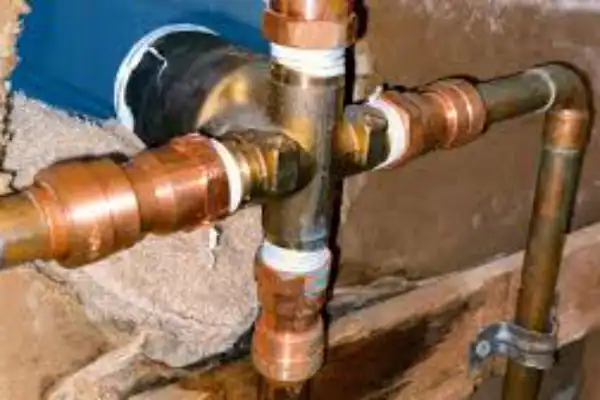
Our stainless steel tees follow international standards. They work well with different connection types. Threaded tees use standard taper or parallel threads. They seal reliably with thread tape or sealant. Welded tees have standard groove processing. Welding is firm with no holes or weak spots. It ensures weld strength and air tightness.
Sealing surfaces are finely turned, deburred, and polished. Surface finish is high. They won’t damage seals or cause stress concentration. Inner walls are smooth with no dead corners. This lowers corrosion and scaling risks. Flow and sealing stay good over long use.
Every batch of tees goes through hydrostatic or air pressure testing. We check for leakage, cracks, or deformation under standard pressure.
4. What is the MOQ for bulk purchases of the tee joint?
Plumberstar has flexible MOQ rules for stainless steel tees. We support sample testing, small trial orders, full foreign trade orders, and project bulk buying. Both stock and customized production are available.
Regular standard models, equal tees, reducing tees, and common sizes. MOQ: 100–500 pieces. Common calibers, 304/316 material, threaded or welded types.Good for foreign trade trials, dealer restocks, and small project purchases.
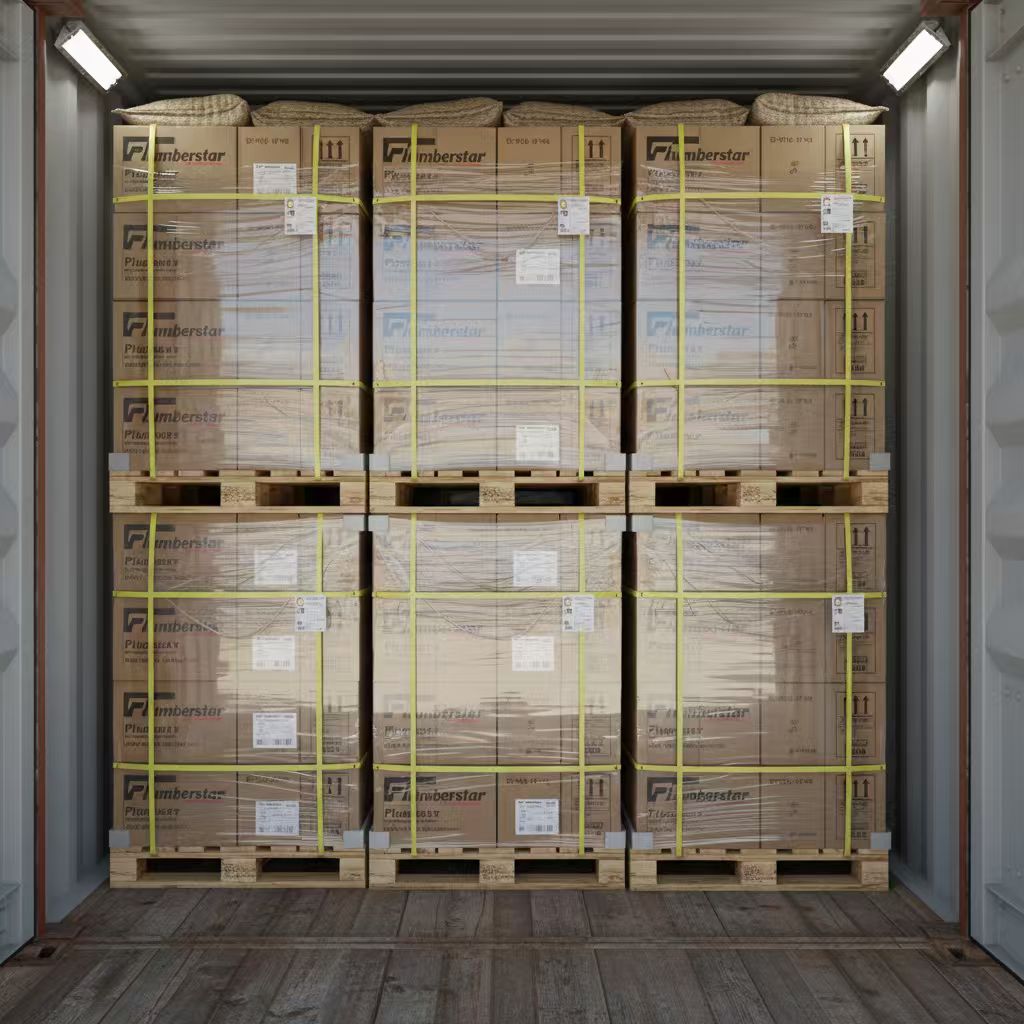
Large orders / full container. No strict upper limit. We can pack up to 20GP/40HQ containers. The more you order, the lower the unit price.Suitable for long-term cooperation, overseas wholesale, and large project procurement.
Customized tees, Non-standard, special material, special size/thickness/surface treatment. MOQ: 500–1000 pieces per specification. We can negotiate based on your actual needs. We try our best to lower the customization threshold.
We also support small trial orders. You can check size fit, sealing effect, and market response. Trial orders use the same production standard as bulk goods. Quality is consistent.
Plumberstar can support you from trial orders to full-container export. We provide a stable, efficient, and sustainable supply.
5. What’s the customization process for non-standard stainless steel tees?
Plumberstar has a mature customization process for non-standard stainless steel tees. We follow strict standards. This ensures precise size, proper threads, reliable sealing, and strong interchangeability.
You just need to provide one of these: drawings (2D/3D), thread standards, sizes, materials, port types, media, and pressure requirements. Or you can send us a physical sample.
Our professional technicians will check: thread type, tolerance, sealing structure, and processing method. We confirm the processing plan and mold/tool needs.
Then we make samples according to the confirmed drawings. We test threads, sizes, and trial installation. We make sure assembly and sealing work well.
After the samples are done, we send them to you. You can test the installation and adaptation. Only after you confirm everything meets your needs — size, structure, sealing —we arrange mass production. This avoids batch errors from the start.
6. Why are Plumberstar stainless steel tee joints a reliable long-term solution?
Plumberstar stainless steel tees provide stable, long‑term performance for piping systems. We control every production step carefully. We design with long‑term safe use in mind.
We only use high‑quality 304 and 316 stainless steel from certified suppliers. The material structure is dense. It makes the tees very durable. They work well in water supply, gas, food, beverage, and chemical industries. After years of use, they won’t rust, crack, or deform. This greatly reduces pipeline damage and replacement from material problems.
We use automatic precision forming and CNC finishing. Inner walls, outer diameters, threads, and sealing surfaces are all highly precise. Tolerances are strictly controlled.
Inner walls are smooth and burr‑free. They lower fluid resistance and prevent build‑up. Even under long‑term pressure and temperature changes, they seal reliably with no leakage. This is very important for safe pipeline operation.
Every batch goes through strict pressure and appearance checks before leaving the factory. Key models get 100% full inspection. We make sure every product meets quality standards.
As a professional manufacturer with independent production, we have a complete supply chain and stable capacity. We can supply you steadily for a long time.
We support long‑term cooperation: fixed standards, locked prices, continuous supply. We provide full material reports, quality certificates, and third‑party testing support. For brand distributors, engineering contractors, and industrial customers, we offer consistent, reliable service through the whole product life cycle.