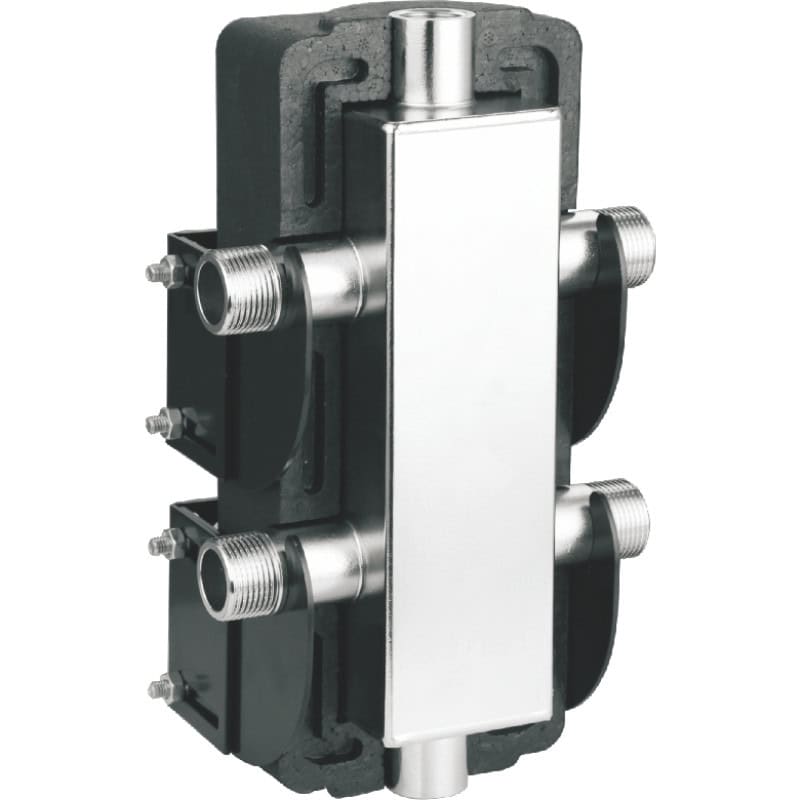
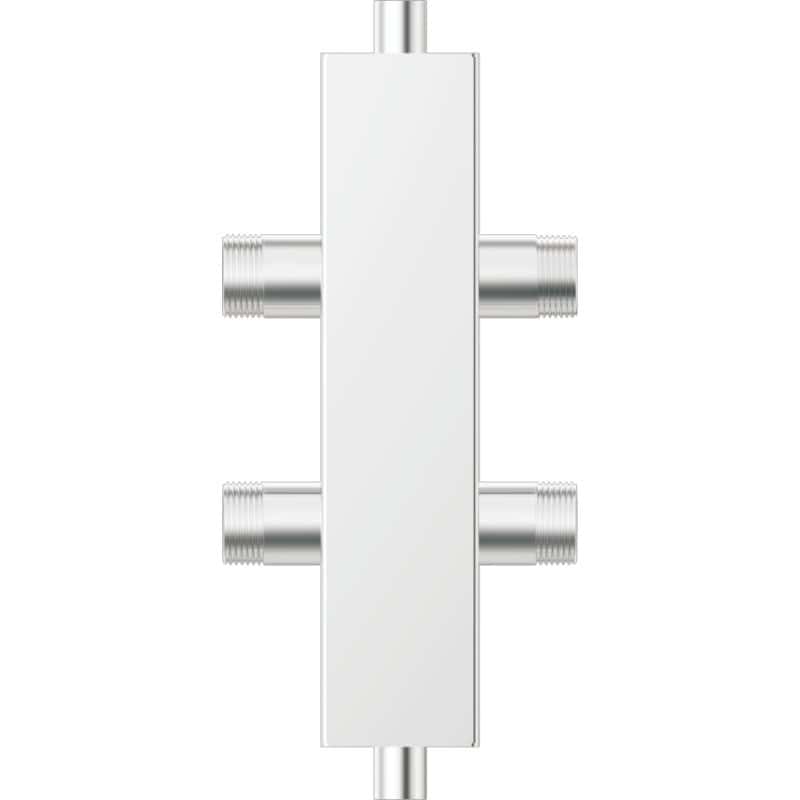
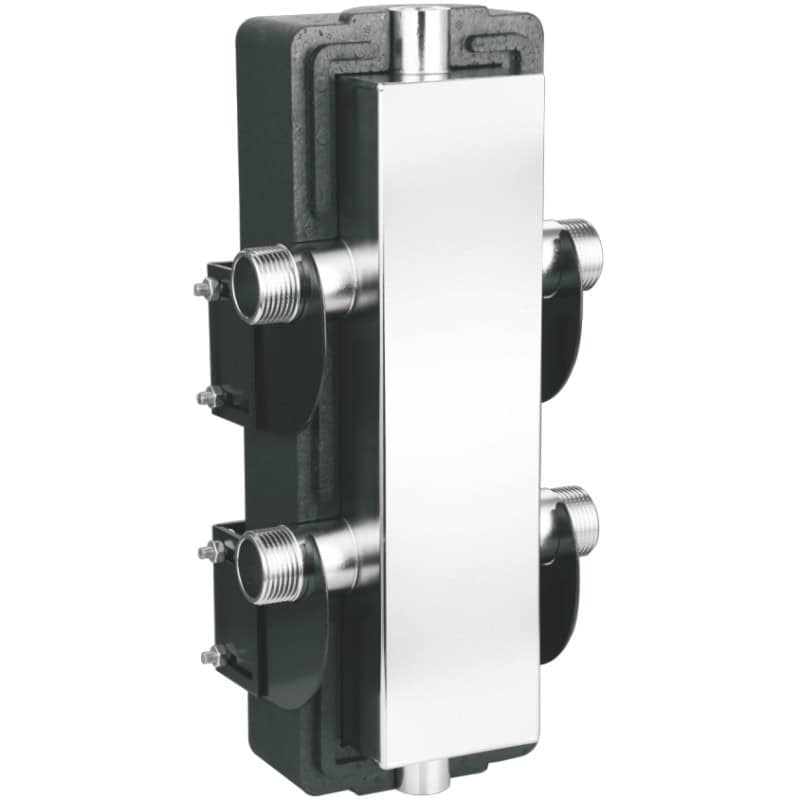
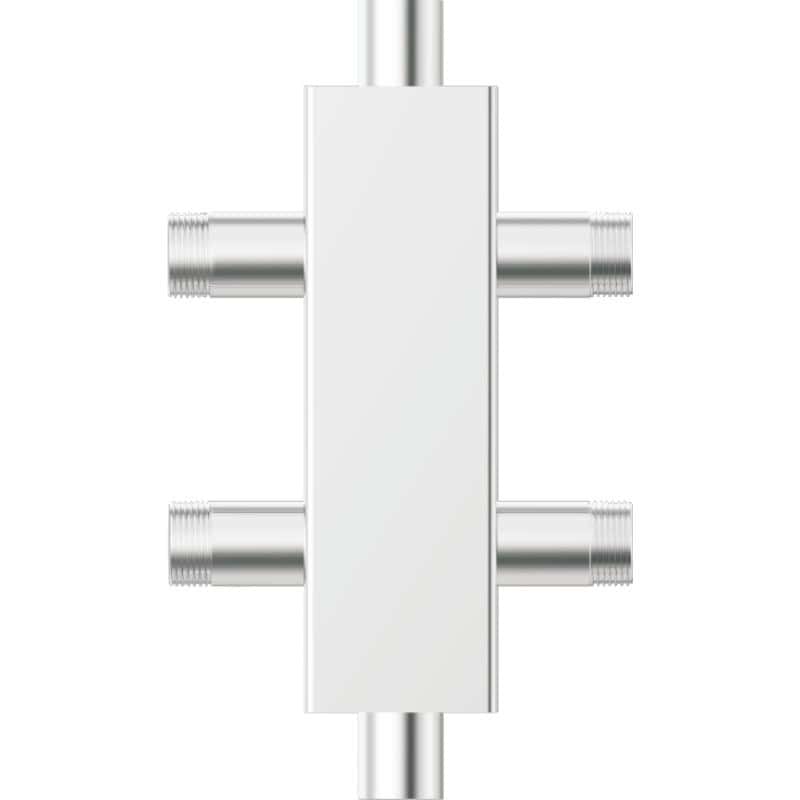
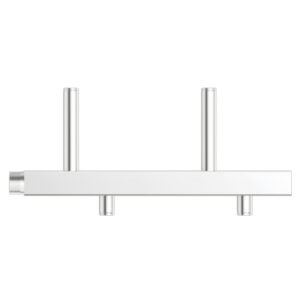
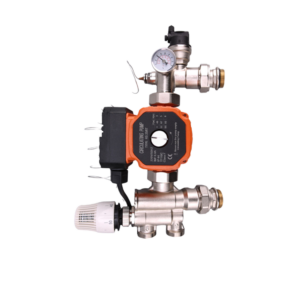
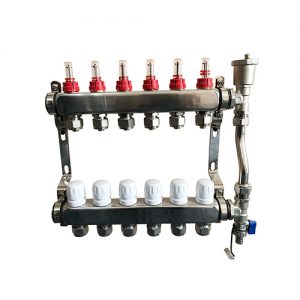
This 2-in-2-out flexible hydraulic separator is designed for wet floor heating systems. It uses a stainless steel main chamber with a plastic mounting bracket to manage water flow in a clear and stable way. Both ends of the main body come with standard external threads. Two external thread branch ports are placed on each side, so the unit fits common heating pipelines. The product is rated for PN16 pressure and works with high-temperature hot water. The inner surface is polished to reduce flow resistance and improve corrosion resistance. A detachable plastic bracket is included for stable mounting. It also makes installation and later maintenance easier. This separator replaces traditional split pipeline layouts and helps improve overall heating efficiency.
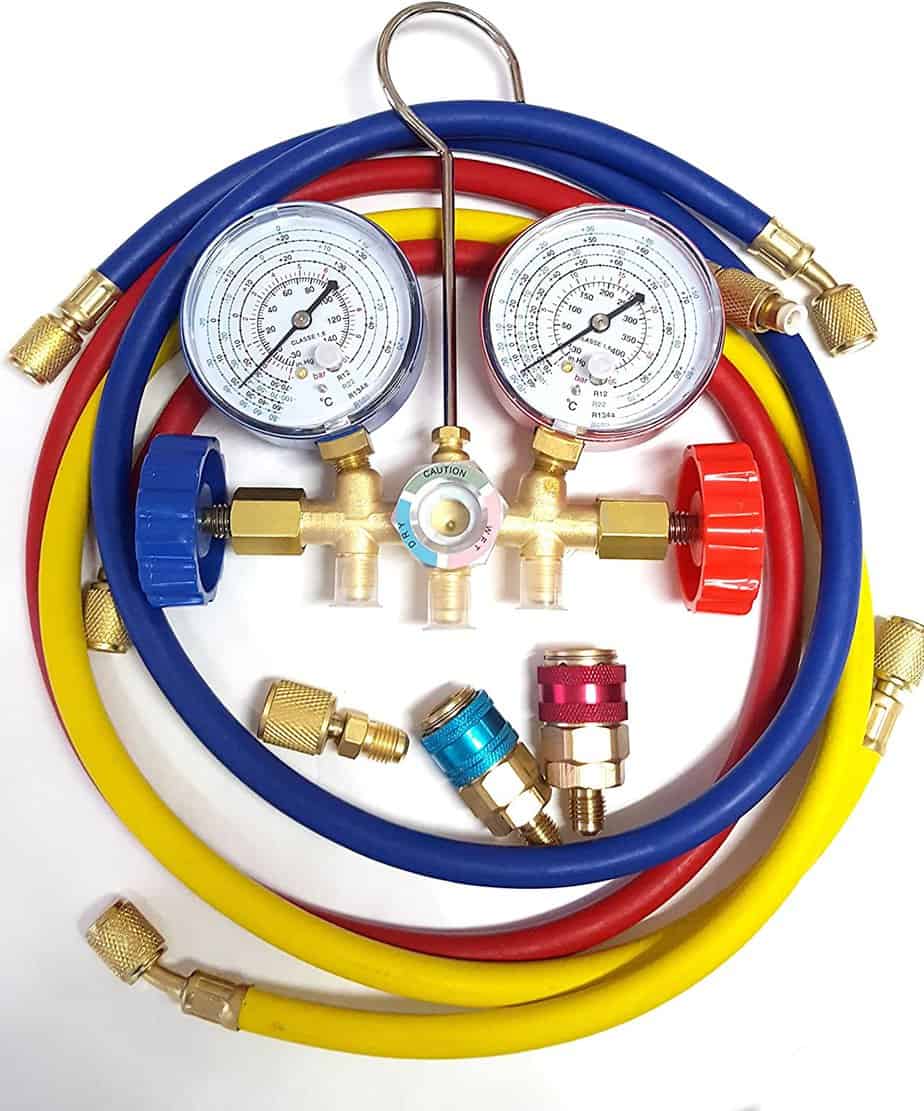
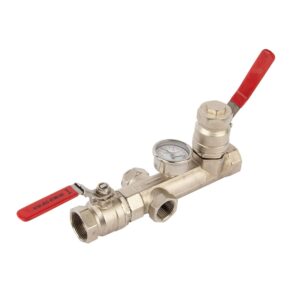
This brass boiler regulator relief valve is used for pressure control and system safety. It is designed for boilers and heating systems. The regulating valve on the left keeps the working pressure stable. The pressure gauge in the middle shows the current pressure in real time.
This brass bathtub and shower constant-pressure valve is used as the main water control part in residential bathroom systems. Its main job is to balance the pressure between hot and cold water lines. When the pressure of hot or cold water changes suddenly, the valve adjusts the mixing of hot and cold water right away. This helps keep the outlet water temperature stable.
Model No.: JX-0952
Material: Brass
Size: 1/2″
Finishing: Original
Intele fitting type: Female
Outlet fitting type: FNPT
Standard: CSA, ULC
Connection: IPS, Sweat(CC)
4 ports
Application: Shower
With a 2-year warranty
1/4 Turn Ceramic Valve
This ceramic valve uses a ceramic valve core and a 1/4-turn shutoff design. It is used for quick on and off control in bathroom plumbing systems. The bottom end connects to a wall-embedded pipe through the mounting base. The side outlet uses a male thread and connects directly to faucet or shower inlet hoses. The ceramic valve core is made for frequent use. It works well for branch flow control in basin faucets and shower lines.
Model No.: JX-0223
Size: 1/2″X1/2″
Material: CW617N, CW602N
Finishing: Chrome-plated and polishing
Working pressure: 16bar
Working temperature: -10-100˚C
Handle: Zinc alloy handle
Connection: BSP/NPT
Standard: ASME
Quarter-turn for on/off
With a 2-year warranty
Brass Union Angle Valve
This brass angle valve with a union joint is commonly used in residential kitchens, bathrooms, and HVAC systems. It uses a 90° handle to turn the water on or off quickly. When maintenance or replacement is needed, the valve can be closed right away. This helps stop the water flow and prevents leaks or overflow. The union joint design allows easy installation and removal. Maintenance can be done without cutting into the main pipeline.
Model No.: JX-0425
Size: 1/2″, 3/4″, 1″
Material: Brass
Finising: Sand blasted, Nickel plated
Handle: T-handle for quick on/off operation
Handle material: Aluminum alloy, Zinc alloy
Working Temperature:-5-120°C
Connection: BS2779, DIN259/ ISO228
Pressure Rating: PN16
Orientation: Vertical installation, right-handle side connection
Valve Structure: Pilot Piston Structure
Application: Cold-hot water installations, oil, and flammable gases
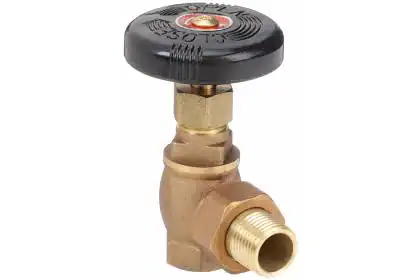
Hot Water Angle Radiator Valve
This hot water angle radiator valve is used as a bypass flow control part in hydronic heating systems. It is designed for radiator applications. The bottom end connects directly to the radiator inlet. The side port uses a male thread and connects to the heating pipe. A black handwheel is mounted on the top. It is suitable for both residential and commercial heating systems.
Material: Brass
Size: 1/2″, 3/4″, 1‘
Body Pattern: Angle
Max working pressure: 125psi
Outlet fitting size: 3/4″
Standard: ISO9001, NSF
Connection Type: FNPT x MNPT Union
Finishing: Sand-blasted
2-pots
Stem material: Brass
Medium: Water
Round handle for on/off
Application: Heating system
Aluminum Alloy Fire Hose Coupling
The aluminum alloy fire hose joint is the core connection fitting of the fire water supply system. It is mainly used to quickly connect the fire hose with the fire hydrant, fire truck, fire gun, and other equipment. Its core purpose is to realize the rapid disassembly of the fire pipeline. It can significantly reduce the time required for pipeline connections and enhance fire extinguishing efficiency at the fire rescue site.
Model No.: JX-0811
Material: Aluminum
Size: DN40,DN65
Storz Coupling
Finishing: Original
Max pressure: 2.5MPa
Operating force: 1.5N/m
No leakage at the internal buckle interface under a water pressure of 0.3MPa
Medium: Water
2-year warranty
Application: Fire Protection System
FAQs of Stainless-Steel Hydraulic Separator
1. What is the function of a stainless steel hydraulic separator?
From Caleffi Hydronic Solutions
The Plumberstar stainless steel hydraulic shunt is designed to address three fundamental requirements of heating and cooling systems: hydraulic balance, clean medium, and stable operation. It combines four core functions to deal with common system problems at the root, and it fits a wide range of industrial and commercial uses.
It separates flow and pressure between the primary side (heat or cooling source) and the secondary side (terminal equipment).
The shunt also ensures accurate distribution of flow. It supports 2 to 12 branches that can be customized as needed. Flow deviation is maintained within ±5%, which helps resolve issues such as uneven heating or cooling in commercial buildings and low heat output in floor heating systems. At the same time, overall system efficiency is improved.
Energy use is also reduced. The smooth internal flow path keeps pressure loss at or below 0.03 MPa, much lower than the typical industry level of 0.08 MPa.
2. Does the hydraulic separator support flow regulation?
Adjustment options
Each branch interface can be fitted with either a manual control valve or an electric control valve, depending on system needs.
The manual version comes with a clear dial and offers an adjustment accuracy of ±5%. It is easy to read and simple to operate, making it a good fit for small and mid-size systems.
The electric version supports PLC remote control and 4–20 mA signal feedback. It allows automatic flow control and works well with smart buildings and centralized industrial control systems.
Control principle
Branch flow is controlled directly by adjusting the valve opening. At the same time, the internal flow channels are designed using optimized fluid dynamics, so each branch remains stable after adjustment, with no obvious fluctuation.
3. What is the manufacturing process of the hydraulic separator?
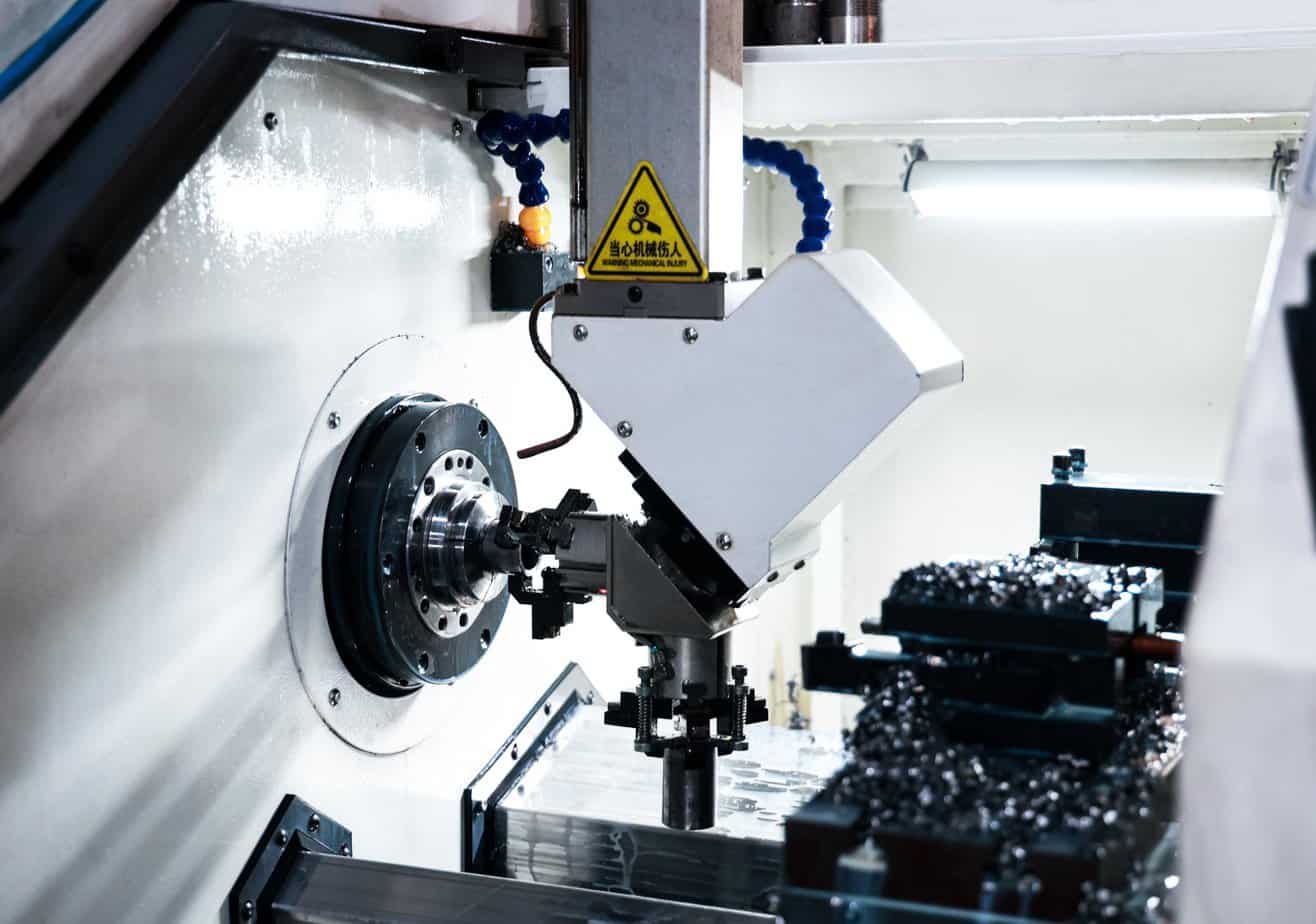
Integrated spinning forming The main body is made using an integrated spinning forming process. A single stainless steel plate is shaped in one setup under CNC control, with no secondary joining. This removes the weld points found in traditional spliced designs.
CNC machining and optimized flow design Production is supported by eight automatic CNC lines. Core dimensions are controlled within ±0.02 mm. Thread connections, branch angles, and other key features comply with ISO 8015 requirements, ensuring the separator is compatible with systems from various brands. The internal flow path is designed using fluid simulation to ensure smooth transitions and eliminate dead zones. With electrolytic polishing, impurity buildup is reduced, and hydraulic resistance is kept to ≤0.03 MPa.
cnc machining
4. What customization requirements does the stainless-steel hydraulic separator support?
Structured and sized to project needs
Shunt structure
The standard design uses 2 to 8 branches. If the system requires more or fewer branches, it can be customized from 1 to 12. Branch sizes do not have to be the same. Branch angles and spacing can also be adjusted to suit the piping layout.
Pipe size options
The main pipe can be manufactured in large diameters, ranging from DN200 to DN300. For compact systems, sizes below DN50 are also available. Branch connections are usually set between DN25 and DN100 and can be selected based on actual flow and load requirements.
Connection types
BSPP, BSPT, and NPT threads are used as standard. If needed, the unit can also be supplied with flanged connections or socket welding ends to match existing piping systems.
Material selection
Materials can be customized to meet specific working conditions and system requirements. Just contact us.
5. What is the difference between a stainless steel hydraulic separator and a carbon steel separator?
Application range
Stainless steel shunts are suitable for commercial and industrial systems, as well as food processing and other applications with higher media and hygiene requirements. They work with different media and can meet sanitary standards.
Carbon steel shunts are primarily used in simple heating systems that utilize clean water. Their application range is limited.
Service life
With better materials and manufacturing processes, stainless steel models offer a service life of 15 years or more. They come with a 3-year warranty and show strong resistance to impact and leakage.
Carbon steel models typically last only 5 to 8 years and carry a much higher risk of failure over time.
6. What additional value can Plumberstar bring to hydraulic separator trade customers?
The long-term value becomes apparent over time, not just at the outset.
Cost optimization: The overall cost is well controlled. With a strong price-to-performance ratio and flexible trial policies, the initial investment is kept low. When it comes to batch orders, pricing remains competitive.
Long-term service. Original spare parts are supplied for the full product life, and remote technical support is always available. This helps customers build local after-sales capability step by step.
Plumberstar also keeps long-term cooperation records with its partners. Product improvements are made based on real market feedback, which helps both sides grow and move forward together.
7. How does design flexibility help hydraulic separator system integrators?
Plumberstar offers full customization, from size and connection type to function and material. This makes it easier to match the real needs of different integration projects.
In HVAC hydraulic distribution systems, the shunt can be made with 1 to 12 branches, even with different branch diameters. Connection types support BSPP, BSPT, NPT, and other common thread standards. This allows for a direct connection to mainstream brands, such as Daikin and Gree, without requiring extra conversion parts.
For water purification system projects, the channel diameter and the filter mesh size can be adjusted based on actual demand. This helps match RO membrane modules with different flow rates.
Due to this flexible design, integrators do not need to add extra adapters because of the poor fit of standard parts. Pipeline resistance and leakage risk are reduced, and system commissioning becomes much easier and faster.
8. Why choose a factory-made stainless steel hydraulic separator?
Optimized flow design for better system efficiency
The Plumberstar R&D team uses fluid simulation to optimize the internal flow path. A smooth, integrated channel design is used to lower flow resistance. Pressure loss is kept at or below 0.02 MPa, which is much lower than that of manually welded products.
The factory-made shunt can also integrate flow sensors, temperature control valves, and other modules when needed. Interfaces follow common standards such as BSPP and NPT, so the unit can connect directly to building management systems for accurate hydraulic control.
Lower cost through scale, with flexible customization
Large-scale production allows Plumberstar to reduce raw material and manufacturing costs. Prices are typically 15% to 20% lower than hand-made products of the same specification.
At the same time, customization remains flexible. Branch numbers can be set from 1 to 12.