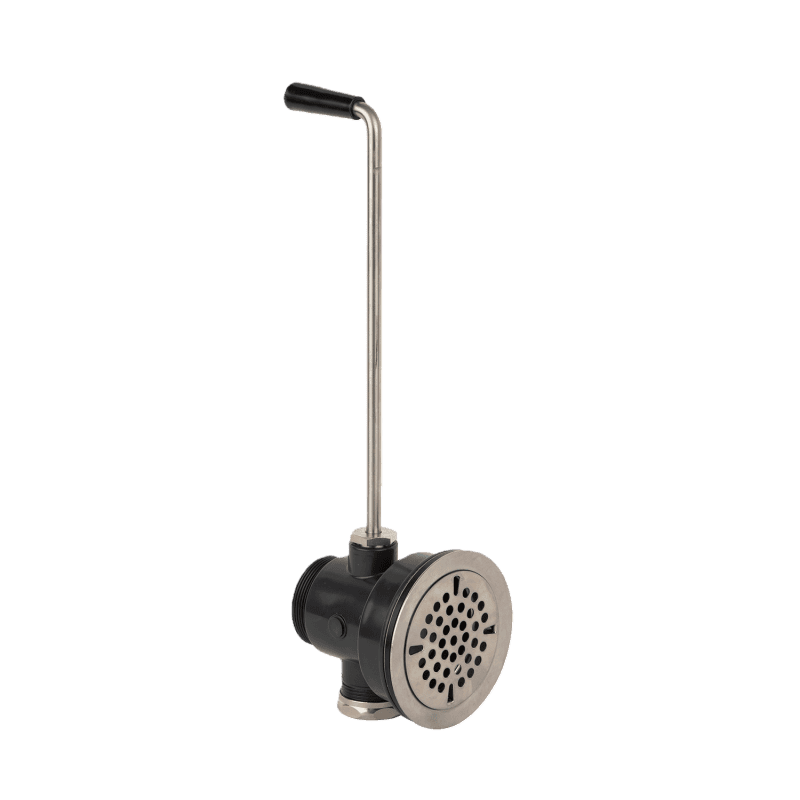
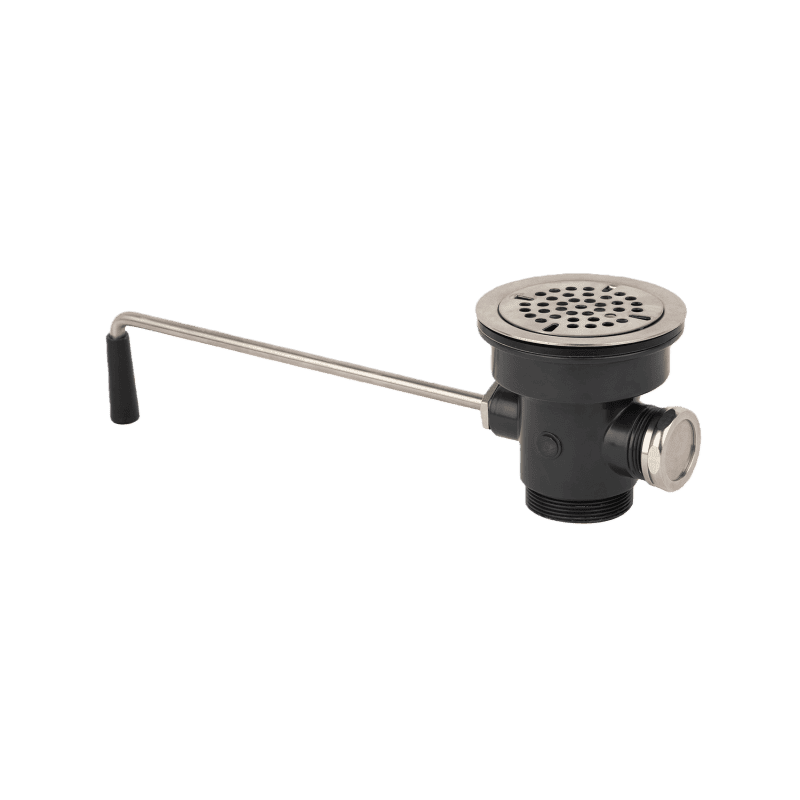
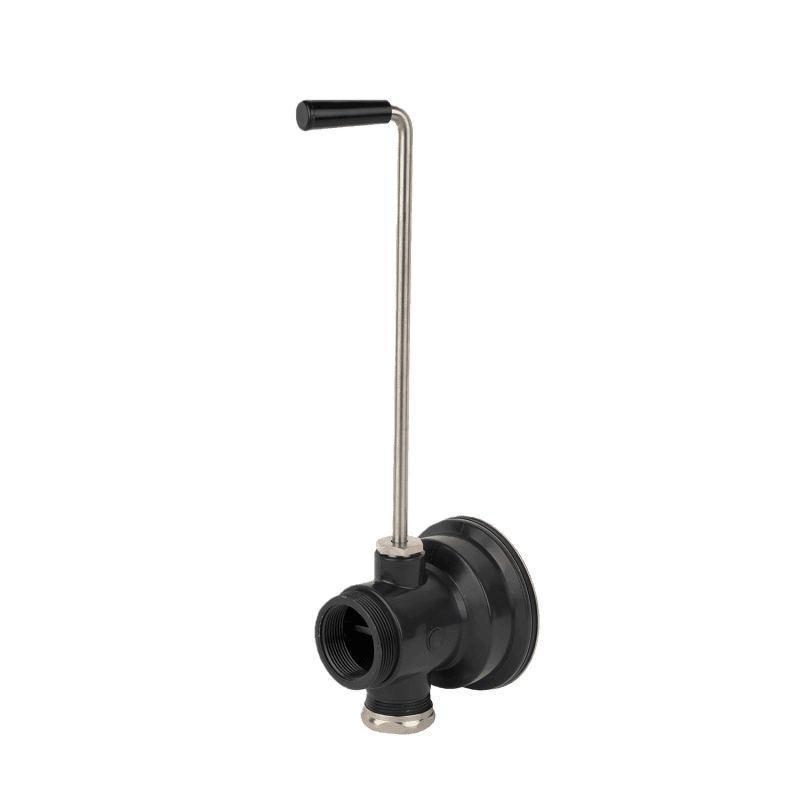
FAQs of Lever Handle Waste Valve
1. What are the opening methods of the Lever Handle Waste Valve?
The opening mode of the Lever Handle Waste Valve is mainly a mechanical linkage structure driven by a lever, which is primarily divided into the following four categories.
- 1) horizontal toggle
Operation mode: handle along the horizontal direction, left and right toggle. The lever is riveted to the valve rod by a pin, and the valve core is driven to move up and down by the lever principle when toggled, thereby realizing the separation/attachment of the sealing gasket and the drain port.
- 2) vertical press
Operation mode: The handle is in a vertical state (flush with the valve body surface or slightly convex). Press the top of the handle to open the drainage, and press again to rebound and close. Some models support a two-way operation, allowing for “press open + pull close” functionality.
- 3) rotary toggle
Operation mode: The handle must rotate and toggle in a combined operation. First, rotate the handle counterclockwise to unlock. Then, toggle to the open position along the horizontal or vertical direction. Finally, rotate in the opposite direction to lock when closing.
- 4) folding lever type
Operation mode: The lever can be folded and stored for easy use. When in use, the handle can be unfolded for toggle operation. When idle, it can be folded to fit the valve body, eliminating the need for extra space.
The handle length (standard 80mm-120mm), toggle direction, and locking function can be adjusted according to customer customization requirements.
2. What materials are available for the Lever Handle Waste Valve body?
The Lever Handle Waste Valve is available in a variety of body materials to suit different use scenarios, media environments, and cost requirements, including PVC-U, ABS engineering plastics, H59/H62 brass, 304 stainless steel, and 316 stainless steel.
1. PVC-U material has strong corrosion resistance, low cost, is suitable for ordinary household cold water drainage scenarios, and can withstand weak acid and alkali media.
2. ABS engineering plastics have excellent toughness and strong impact resistance, suitable for commercial kitchens, public toilets, and other high-frequency use environments, and may be used in a slightly collision-prone environment.
H59/H62 brass material has good sealing performance and high temperature resistance (≤ 120 ℃). After lead-free treatment, it conforms to EU RoHS and US NSF 61 standards. It is suitable for high-end bathrooms, hot water drainage systems, and drinking water-related scenarios.
3. 304 stainless steel material has outstanding anti-rust performance, suitable for wet, mild corrosion environments, such as residential and commercial buildings.
4. 316 stainless steel adds the molybdenum element to 304, and the corrosion resistance is greatly improved. It can withstand environments with strong acids and alkali drains, as well as outdoor conditions with high salt fog.
3. Does the stainless steel Lever Handle Waste Valve support magnetic detection?
Stainless steel lever handle-type wastewater valve supports magnetic detection. The 304 stainless steel valve body is usually non-magnetic or weakly magnetic. In comparison, the 316 stainless steel valve body is also mainly non-magnetic, which can be quickly identified by professional magnetic Detection Tools. Products in the production process undergo strict material composition testing and quality control to ensure that the stainless steel material purity standards, as well as magnetic test results, do not affect the valve body’s rust resistance, corrosion resistance, and structural strength.
4. Can the Lever Handle Waste Valve be used in drainage scenarios with corrosive liquids?
The Lever Handle Waste Valve is suitable for use in drainage scenarios involving corrosive liquids. Suitable materials should be selected according to the type, concentration and temperature of corrosive medium: conventional PVC-U material can withstand weak acid-base liquid with pH value of 4-10, suitable for ordinary commercial kitchen, hospital toilet and other scenes; ABS engineering plastic has stronger corrosion resistance and can cope with moderate and mild corrosive medium with pH value of 3-11; If it is a strong acid and alkali scene, it is recommended to use 316 stainless steel material. The molybdenum added can significantly improve the corrosion resistance and can withstand corrosive liquids with a pH value of 1-13. In special high-temperature or corrosive medium environments, fluororubber seals and a strengthened valve body structure can be customized to ensure the valve remains leak-free and undamaged for an extended period.
5. What is Lever Handle Waste Valve packaging? Can you customize packaging?
The packaging of the Lever Handle Waste Valve features a single set of products, which are initially packed into a neutral white box. The box is then equipped with built-in shock-proof foam or pearl cotton, and it is attached with installation instructions, spare gaskets, and other necessary accessories. Every 20-30 sets are packed into a five-layer corrugated outer box. The surface of the outer box is marked with product model, moisture-proof, and fragile marks to ensure drop resistance and pressure resistance during long-distance sea and air transportation. Packaging support provides customized services, ensuring that packaging meets the minimum order requirements and can fully adapt to customer brand promotion and overseas market access needs.
6. Does Lever Handle Waste Valve support third-party inspection?
Lever Handle Waste Valve supports third-party inspection services. Customers can independently designate SGS, Intertek, BV, TÜV, and other international authoritative testing organizations. Test items can cover material composition analysis, sealing performance, corrosion resistance, compressive strength, and other relevant properties. During the testing process, we will fully cooperate in providing samples, technical specifications (TDS), material certificates (COA), and other relevant materials. After testing is completed, we can offer a comprehensive third-party testing report, which can be used for customer product certification, market access filings, and project bidding, among other purposes, to ensure that the product quality meets the stringent requirements of customers and target markets.
7. What is the connection between the lever handle and the valve stem of the Lever Handle Waste Valve?
The lever handle and stem of the Lever Handle Waste Valve are connected in two main ways. The standard model adopts a stainless steel pin riveting process. The pin passes through the reserved hole of the handle and valve stem and is fixed at both ends. The connection strength is high. It can withstand ≥ 10,000 repeated opening and closing tests and is not easily loosened or broken. The high-end customized model adopts integrated injection molding or welding fixation. The handle and valve stem are seamlessly connected. The mechanical strength is better and suitable for commercial high-frequency use scenarios.