Introduction
Thermostatic radiator valves are responsible for maintaining a constant temperature in a room. These are known as TRVs, which can sense the room air temperature. We can get the expected ambient temperature by this. After that, these valves adapt the heat output of the radiator. These valves can also adjust the flow of hot water. It has better control & adjustment, which is energy-saving & money-saving. Thermostatic radiator valves can control the temperature at the turn of a dial. It decreases energy consumption. It can also save money in the long run.
When the room temperature reaches the preferred level, the valve closes to stop the water flow. This can prohibit the radiator from getting hotter, which is a tremendous mechanism of TRV. It means you heat the room to a higher temperature than needed. It also allows individual room heating. A rarely used room can be heated to a lesser temperature than a more-used room. Thermostatic valves are simple in straight and angled designs.

Technology is developing daily, and it works smoothly. Everyone loves an automated machine. TRV is a part of modern home technology. It has revolutionized home temperature control systems. New-generation plumbers are now working on balancing radiators, which is like a treasure.
Radiator valves are a vital part of its functions. It controls the stream of water through pipes. It ensures the effective & efficient heat-up of the radiator. This makes our home nice, comfortable, and warm.
Thermostatic radiator valves work independently of the boiler and affect the temperature that the wall-mounted thermostat senses. The specialists recommend not using thermostatic valves where the wall thermostat is situated. The two thermostats will collide to increase or decrease the heat needed to warm the space. Now, electronic actuators can control radiators remotely. It can be prevented from anywhere with granular control from a smartphone or laptop.
TRVs can be used for one-pipe steam. It doesn’t work like two-pipe steam and hot water radiators. One-pipe steam radiators are controlled at the inlet side. They are filled with air before a heating cycle starts. The steam will get in when that air can get out. Setting up a thermostatic valve between the radiator and the air vent is helpful. It can control the amount of air that can get out, which affects the amount of steam that enters the radiator.

Installation of Thermostatic Radiator Valve
In a high-temperature radiator system, we will have a noncondensing heat source. We have to mount a TRV on each radiator. The thermostat starts or stops the boiler and pump. You can put a TRV on every radiator if you control the boiler with an outdoor reset controller. When the warm weather shutdown function works, placing a jumper on the boiler is necessary. The boiler will be on and off depending on the high limit setting differential. It will also add the required heat. When the outer side gets hot, the boiler will turn off. We can use a flexible speed pump for this format.
This type of setup is better for a boiler with good thermal mass, such as a cast-iron boiler. Some noncondensing boilers, like copper fin-tube, are also available. These have low weight and the lowest flow rate.
In a high-temperature baseboard system, you can use a fin-tube baseboard. It can be used instead of radiators as a heat emitter. Here, TRVs can work as accurately as radiators. You install them differently. People install fin-tube baseboards in a series loop. It’s a common practice. It means there are many baseboard units connected in series. These span multiple rooms. In this system, there should be a thermostat in a central location. It helps to control that zone.

You can use a TRV with a three-way diverting valve to achieve individual room temperature control. This valve is attached to the baseboard heater’s supply. Then, a bypass pipe should be linked to the bypass port on the TRV. There are a lot of control options available for this setup. In one, you need to drill a hole through the face. You can do it at the end of a baseboard end cap. The TRV sensor head will project through the hole. It allows temperature detection and fine-tuning.
You may need to set up a three-way TRV if you have several baseboard heaters in one room. This TRV should have a remote wall-mount control head. The bypass pipe would ride from the TRV valve to the arrival of the last baseboard in the room. In this setup, you can use a centrally positioned thermostat. It helps to turn the boiler on and off. The TRVs act like dynamic balancing devices. It allocates the BTUs through the home, equivalent to the temperature setting in each room.
It has a particular advantage. There is no flow trouble from the boiler side, although it is sometimes slowed down. This makes it easy to choose a low-mass boiler and a high-mass boiler.

A thermostatic radiator valve is one of the best pieces of equipment for reducing problems in small areas, which we can call miniature zones or microzones. We can compare these zones’ heat load to the total area. The boiler will short-cycle if the microzones need heat while none of the other zones do, reducing TRV efficiency.
The TRV piping going to the heat emitters should be tied. It should be in the boiler distribution piping. It will help get the flow whenever any of the other zones turn on. It allows the area to accept the heat. The heat can be permitted whenever there is a demand in the building. The TRV will stop overheating the room. The small zones cannot reach the boiler for heat. This will not affect any short-cycling troubles.
This setup is used in bathrooms or washrooms with radiant floor heat. Bathrooms often do not have huge floor space. A window and an exterior wall are good in there. This small floor space pushes the heat load up. BTU/hour per square foot requirements will also be larger than the rest of the house. It is the room where we should not consider installing a thermostatic valve. Momentary heat from a shower or bath may block it.
We can increase the heat output by changing the tubing space. The floor will get a uniform temperature by spacing the tubing at 4 inches. Generally, people space the tubing at 8 inches.
The Thermostatic radiator valve always maintains the flow going through the tube. It prevents the whole room from getting warm while keeping the floor warm more of the time.
We can summarize Thermostatic Radiator Valve Installation in the following Steps
· Sewer water from the radiator.
· Use pipe wrenches to separate the old valve from the radiator.
· Eliminate the spud using a spud wrench and pipe wrench.
· Give force to the thread sealant on the new spud.
· Wrap single-strand wicking around the spud threads.
· Install the new spud with a spud wrench and pipe wrench.
· Use pipe dope and single-strand wicking on the existing pipeline.
· Install the new TRV and tighten it with a pipe wrench.
· Use pipe sealant on the face of the spud.
· Tighten the joint between the spud and the new valve using a pipe wrench.
· Make a hole in the radiator cover.
From Mill Gap Farms· Put the wire through the hole & screw the sensor.
· Make a connection of the sensor wire to the valve.
· Slide the radiator cover.
Working Principle of Thermostatic Radiator Valve
The thermostatic radiator valve’s working function is not typical. We can start describing it with the Sensor Head. Inside the sensor head, there is a sensor element. It is a small vessel occupied with an elastic liquid or wax. The liquid/wax expands with the temperature rise. It helps open and close the valve disk according to the increase or decrease in ambient temperature.
The control head of TRV works almost the same way. The control head mounts to the valve body. It actuates the valve directly. Sometimes, you can find the capillary tube filled with an incompressible liquid. These are all to open and close the valve.
When the thermal element in the sensor head is heated up, it enlarges & drives on a diaphragm. Incompressible liquids exist on the other side of the diaphragm. It gets pushed through the capillary tube and drives the diaphragm in the actuator. The diaphragm then pushes down on the stem of the valve body. It causes movement of the valve disk toward the valve seat. Finally, it makes the valve close.
At the time of cooling off the sensor, an opposite incident happens. There are springs to provide force & motion. It helps the valve open as the thermal element cools down. The valve is still available when a zone reaches the setpoint temperature. It will be a fraction. It allows a little bit of flow. The valve always functions within the last millimeter of its stroke. Maybe it was due to a mechanical error, but it is considerable. At that time, the valve modulates the flow with temperature changes in the room. While most thermostatic valves cost less, ones with more efficient liquid sensors can be more expensive.
Features & Benefits of Thermostatic Radiator Valve
Low energy bills: The thermostatic radiator valve helps you save money by regulating the temperature of different radiators. The valve fits onto your current radiator and has a sensor. This sensor consists of liquid or wax. When the temperature set on the valve reaches, the sensor expands, preventing extra hot water from flowing into the radiator.
High efficiency: Efficiency depends on output performance. Since TRVs are automated devices, they are highly efficient. Any efficient radiator valve can fulfill your demand by functioning correctly.
Lower heating service cost: Monthly or yearly heating service is very cheap at the thermostatic radiator valve.
Adjustable comfort levels: A poorly insulated home will not fully benefit from a thermostatic radiator valve. The sensors inside the valves of this kind of home react with ambient temperature, which can easily make the sensors sense that the room is colder or warmer.
User-friendly setup and installation: The installation process is simple. A homeowner can easily set up a TRV. Before that, he should know the parameters and follow the installation guidelines.
Reliable and silent heating: Thermostatic radiator valves rarely malfunction or cause hazardous problems. This is because of their automatic work procedure.
Thermostatic radiator valves offer a profitable method to achieve better energy efficiency. It smartly controls the temperature room by room. It shuts off automatically when the need for heat is fulfilled. It has a limited range of tuning to avoid tampering. There is a simple plumbing procedure. Cost is remarkably low compared to the savings you’ll see in your heating bills year after year. TRV provides you with optimum comfort while decreasing energy waste and heating costs. We can use a remote sensor to sense air temperature correctly. It helps to find out whether valve placement is difficult or impossible. TRV responds precisely like a standard valve. These valves must be placed behind curtains or inside boxes. The room thermostat is set at the optimal point on the wall. It is used to control one or more valves.

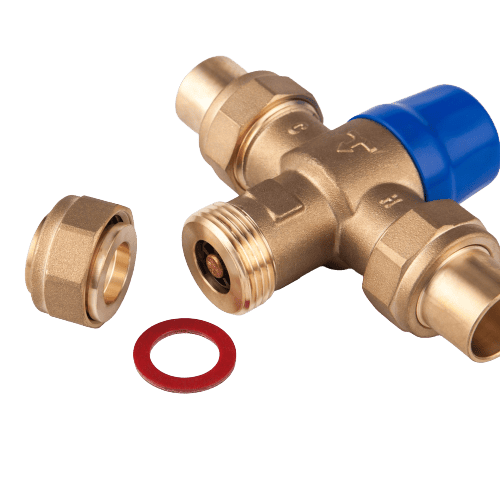
Ideal Thermostatic Radiator Valve Specifications
· Highest Operating Pressure 145 psi
· Highest Water Temperature 248°F
· Certified ISO 9002
· Liquid-Filled Sensor Component
· Time Constant: 6 min
· Hysteresis <2°F
· Ambient Temperature Range 46°F to 83°F
· Normal Setting 68°F
· Frost Setting 46°F
· Highest Differential Pressure 8 psi
· Highest operating pressure 145 psi
· Highest water temperature 248°F
· Polished chrome finishing.
· One valve for copper compression or iron pipe threads
· Double O-ring seal and non-rising spindle
· O-ring seal on a watertight seal
· Copper compression or female pipe thread inlet
· All valves are shipped with nominal 1/2″ threads and a matching compression nut and ferrule.
A thermostatic radiator valve is a piece of non-electrical, mechanical equipment. It controls flow based on ambient room temperature. When the room heats up, the TRV slows down the flow. When the zone cools down, the TRV permits the flow to increase. A TRV can be used to regulate a single heat emitter. Multiple emitters can also be controlled in a zone.