The globe and gate valves are significant industrial valves. They both perform numerous tasks with their compatible structures. Despite ruling the industry for decades, they are mistaken for each other. Their appearance makes them look alike, but they have differences in their work. Here are the differences between globe and gate valves to better understand them.
Globe Valves:
Globe valves are linear-flow valves, and their structure makes them appear as a globe. They must regulate the flow by stopping or allowing fluid motion. The valve often comes with an actuator or handle at the top. These are throttling valves with higher pressure at one end and lower pressure at the other.

The flow of media in globe valves is parallel to the seat component. This structure enables a powerful and effective seal against leakages. They are also less prone to seat erosion in the valve’s open condition. They undergo high-pressure drops. Due to these properties and many others, globe valves are well-suited for use in heavy-duty applications.
| Product Name | Brass Globe Valve |
| Materials | H58-3, CW617N |
| Size | 1, 1/2, 3/4,1-1/4″,1-/12″,2″ |
| Media | Water, steam |
| Thread Connection | NPT, BST |
| Temperature | -10°C to 120°C |
| Working Pressure | 16 Bar |
| Applications | As selector valves, throttling valves, and fluid regulation valves. |
Globe valves are best for high-pressure, temperature, and abrasive media systems. These valves are highly efficient in combating corrosion and offer excellent leak control. The globe valve body is designed to enable a change in flow direction within the body. This change can lead to turbulence and a pressure drop. Thus, avoiding them where pressure drop and flow resistance are undesirable is better.
Gate Valves:
The gate valves work by placing a wedge or rectangular-shaped gate to obstruct fluid. The wedge disc can be either solid or flexible. A threaded stem generally operates the valve connecting the stem to the actuator. Rising and non-rising stem gate valves are the most commonly used types of gate valves. The rising stem shows the valve’s status to the viewer by its rising structure.
Gate valves are typically non-regulating valves; they either stop or allow fluid passage. The partial opening of the gate valve can lead to excessive wear. They are efficient for both above-ground and underground applications. They are ideal for providing a leak-proof, tight seal. Unlike globe valves, these are unsuitable for throttling, as they can damage the valve.
| Product Name | Heavy Duty Bronze Gate Valve |
| Materials | Bronze with sand-blasted finishing |
| Size | 1-1/2, 1-1/4, 1, 1/2, 2, 3, 3/4, 4, 5, 6. |
| Media | Gas and Liquid |
| Thread Connection | NPT, BST |
| Temperature Range | 210°C to 180°C |
| Working Pressure | 0 to 20 bar |
| Applications | Applicable for handling a wide range of gases and liquids. |

These valves provide a smooth linear flow of fluids with minor flow restrictions. This property makes them the best choice to avoid pressure loss. They require multiple turns to open or close due to their design. They perform well in petrochemicals with high-temperature and low-pressure media.
Globe Valve vs. Gate Valve: Differences.
The globe and gate valves differ in almost every aspect. Here are the differences between globe valves vs. gate valves.
Structure:
The most evident difference between globe valves and gate valves is their structure. A globe valve has most of its components hidden in the body, giving it a complex system. This design enables throttling. It also helps fluid change its flow direction.

Gate valves, on the other hand, consist of a fundamental structure. They have all their parts in the upper valve body. Their stem can be rising or non-rising. Their height is usually greater than that of the globe valves in the open position.
Working:
Globe valves provide a linear flow mechanism for regulating fluid flow. On turning the valve stem, the disc lowers or raises. It modulates the flow by adjusting the position of the disc relative to the seat. Globe valves are ideal for flow modulation as their design enables precise flow. They also have excellent shut-off capabilities upon closure.

Gate valves have a wedge or gate to carry out a fluid control mechanism. Yet, they cannot regulate media flow but only allow a flow path or shut it off. In open conditions, the gate lifts completely out of the press to pass. While in a closed position, the valve lowers down to block the fluid passage. They offer the least flow resistance, which results in a shallow pressure drop. These valves can serve tight seals and less pressure drop applications, but not for flow regulation. Thus, the differences in gate valve vs. globe valve working are inevitable.
Design Variations:
Globe valves usually come with two design patterns. The first is a tee pattern that gives a straight path for flow in open conditions. It has an inlet and outlets aligning in a T shape. This design of globe valves serves a range of applications. The second design features an angled pattern with inlets and outlets at 90-degree angles. This one has improved flow characteristics with less pressure drop than the tee type.
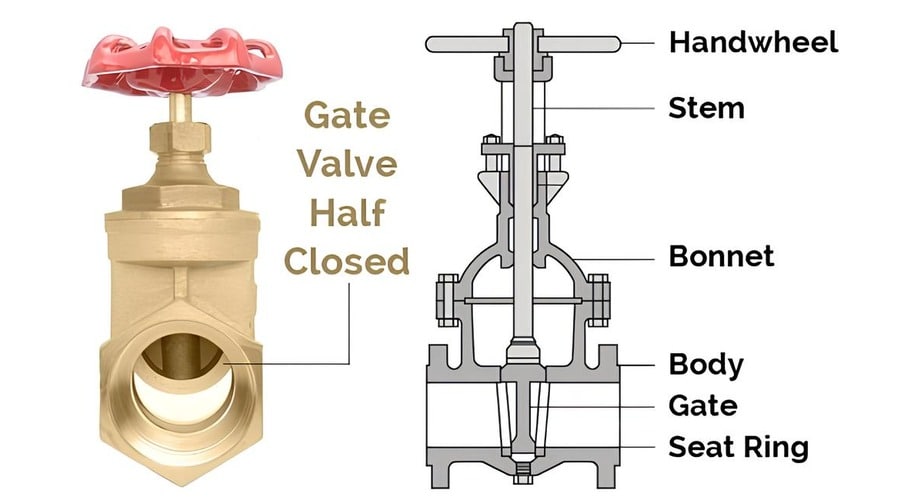
Gate valves come in different designs, including flexible, solid, and split wedges. A flexible wedge has a gate of two or more pieces, giving an adjustable mechanism. It is best for applications with temperature variations as it can contract and expand. A solid wedge is a single-piece solid wedge and can provide a tight seal. A split wedge has a gate that divides it into two halves. It is best to deal with high-pressure applications.
Sealing Properties:
Sealing marks another difference between globe vs. gate valves. In globe valves, a ring-shaped seat serves as a sealing element. The disc presses against this seat in the closed position, creating a tight seal. It makes globe valves an excellent choice for avoiding leakages and producing strong seals. Thus, they are best suited for applications that require precise control with minimal leakage risk.
The gate valves, on the other hand, have varying sealing properties. A gate or flat wedge brings in the sealing by connecting with the valve body. The gate connects with the seat, closing the valve and creating a tight seal. It results in an efficient shut-off property by providing complete isolation. But they are unable to regulate flow like globe valves.
Pressure Drop:
Due to their internal components and design, Globe valves offer more pressure drop. This is because the flow path in globe valves can be curvy, and the movement of the disc resists flow. They control flow rates well but can trade a slightly higher pressure drop. The gate valves differ from globe valves in pressure drop quality.
The gate valves offer opposite features in terms of pressure drop. Their design is such that it results in the minimal pressure drop within the valve. This is because the internal parts of the gate valve tend to create very low resistance against flow. But at the same time, they cannot suit applications that require good flow regulation. Hence, pressure drop should be considered while choosing between a globe valve and a gate valve.
Applications:
To understand the differences between the two, it is essential to list globe valve vs. gate valve applications. Globe valves are suitable for getting precise flow control. They are efficient in applications involving flow regulation. Globe valves are applicable in HVAC systems that regulate hot and cold water flow. In steam applications, they control steam distribution and regulate chemicals in chemical processes. They also perform well in accurately controlling chemical dosing during water treatment.

Gate valves perform distinctive functions from globe valves and thus differ in applications. They are best for flow isolation and low-pressure drop applications. In wastewater treatment plants, gate valves stop the water flow without offering resistance. In the oil and gas industries, they can shut off the flow between different sections of pipelines. They are also applicable in petrochemicals for the entire shutdown and high-pressure controls.
General Differences Between Globe Valve and Gate Valve:
Below are listed several general differences between the globe and gate valves.
| Property | Globe Valve | Gate Valve |
| Function | Throttling and precise flow control. | Not for flow control, it provides flow isolation. |
| Flow Control | Excellent for flow control. | Not suitable for flow control. |
| Closure Element | A disc or a plug. | Flat gate or a wedge-shaped gate. |
| Pressure Drop | Moderate to high-pressure drop in the partially closed position. | Low-pressure drop in open conditions. |
| Shut-Off Capability | Excellent when fully closed. | Excellent when fully closed. |
| Leakage Prevention | It is effective for preventing leakage, but can sometimes be prone to leakage. | It is very effective and can achieve zero leakage. |
| Flow Isolation | Less efficient than gate valves. | Ideal for complete flow isolation. |
How to Choose?
The gate vs. globe valve comparison indicates several plus points in both valves. To choose one of them, consider the valve’s features that suit your application. You can rely on the factors below to learn how to choose between a globe valve and a gate valve.
Globe Valve:
●Precise Flow Control: Globe valves are excellent throttling valves and offer precise flow control. They are also famous for their flow regulation property.
●Shut Off: Globe valves perform well when applied in sensitive environments due to reliable shut-off. They prevent leakages by giving a tight seal.
●High-Pressure Drop: These valves may not be suitable for applications with strict pressure loss constraints. This is because the design of globe valves offers high-pressure drops.
Gate Valve:
●Flow Isolation: Gate valves are perfect for providing complete flow isolation. They also offer negligible resistance to the flowing media.
●Low-Pressure Drop: These valves are desirable in applications where maintaining high flow pressure is mandatory. The structure of the valve allows for low-pressure drops while in the open condition.
●No Flow Regulation: Gate valves are not throttling valves and thus are not meant for flow regulation. Using them for flow modulation can lead to valve damage.
These are a few points of comparison that can help you choose between globe valves and gate valves.
The Bottom Line:
A comparison of globe and gate valves reveals the differences in their performance and structure. Both have specific properties that can be reliable in relative applications. Determine your application’s needs and preferences before choosing between a globe valve and a gate valve. Select from the best and most reliable wholesale plumbing suppliers to get more from these products.
Frequently Asked Questions.
Can I use a globe valve for isolation purposes?
Due to their design and construction, globe valves are not well-suited for isolation. It is better to use them for regulating the flow.
Are gate valves applicable for corrosive fluids?
Special gate valves can be applicable for corrosive media. For this purpose, the gate valve construction includes resistive materials that can handle such fluids.
Do gate valves reduce the pressure of the fluids?
Gate valves prevent the pressure waves and drop the pressure while opening and closing. Thus, gate valves should be applied for the shut-off mechanism, not for media modulation.